

ERTMS and ETCS explained: how European train control works
How ETCS works, what Eurobalises do, the levels after the 2023 TSI, how it compares with AWS/TPWS and TVM, and why the European rollout is slow: our expert-checked guide.
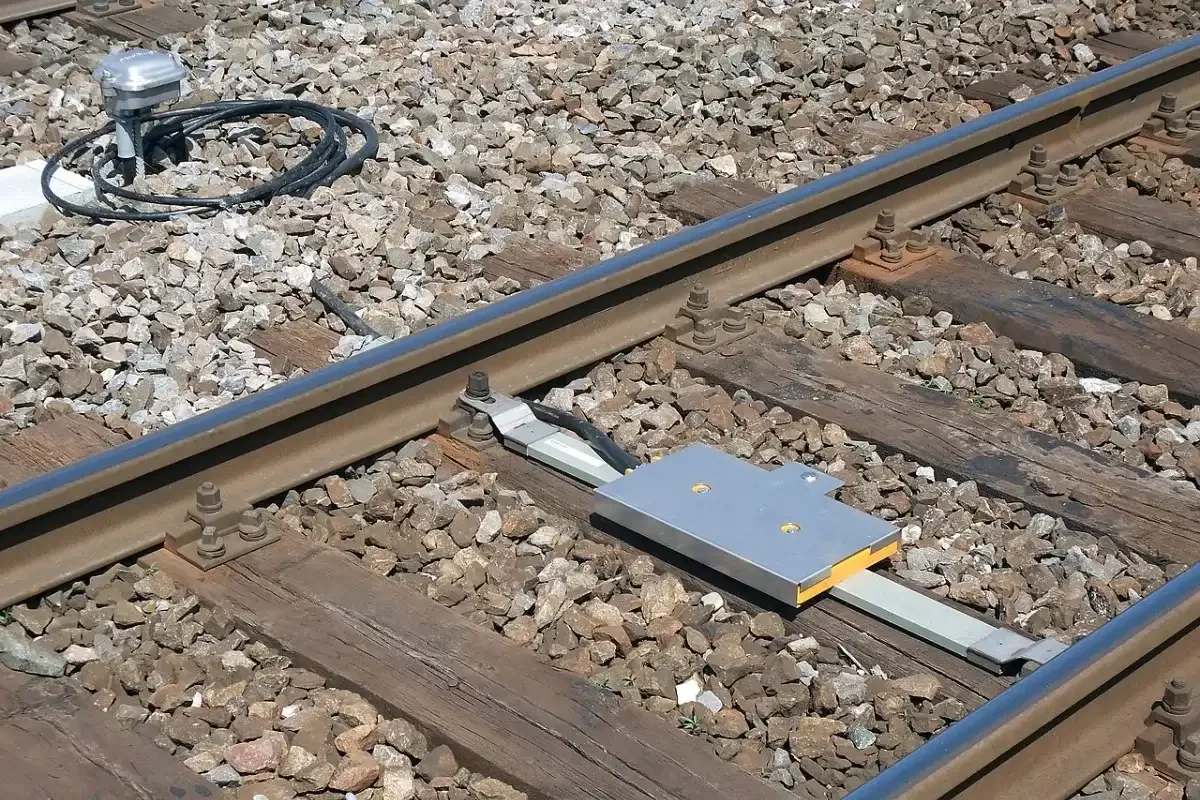
Photo: a Eurobalise fixed between the rails. Kecko, CC BY 2.0, via Wikimedia Commons.
ERTMS is the signalling system the European Union is gradually requiring on its main lines, to replace the twenty or so national systems that stop a train from crossing a border without changing equipment. At the end of 2024, ETCS, its technical core, covered about 12,400 km of the trans-European network, barely 10%, according to the European Commission. This guide explains how it works, how it compares with older systems such as AWS/TPWS, TVM or LZB, and why the rollout is taking so long.
ERTMS, ETCS and GSM-R: who does what
ERTMS (European Rail Traffic Management System) is the name of the whole package. It has two building blocks. ETCS (European Train Control System) is the train protection layer: it tells the train how far it may go and how fast, then checks that the driver stays within those limits. GSM-R is the digital railway radio that carries messages between track and train at Level 2. It will be replaced from the end of the decade by FRMCS, which is based on 5G.
People often use "ERTMS" and "ETCS" interchangeably, but the difference matters. A network can have GSM-R without any ETCS yet, and it is ETCS that costs the most and changes the way trains are driven.
The principle: a movement authority and a braking curve
With conventional signalling, the driver reads lineside signals and adjusts speed. With ETCS, the information appears in the cab. The trackside sends the train a movement authority, a point it must not pass, together with the line speed profile. The onboard computer (EVC, European Vital Computer) constantly calculates the braking curve needed to stop before that point, taking into account train mass, braking performance and gradient.
The driver follows this on the cab display (DMI). If the train exceeds the permitted speed, the system warns the driver and then brakes automatically. It does the same safety job as TPWS in Britain or the KVB in France, but with a language shared across Europe.
To know where it is, the train combines two sources. Eurobalises, small units fixed between the rails, give it a reference position each time it passes over one. Between balises, odometry (wheel sensors, radar, accelerometers) estimates the distance travelled. This is a weak point: the RAIB investigation into an incident at Welshpool, on the Cambrian Line in Wales, found that a wrong wheel diameter, left in memory after maintenance, made a train that had stopped in the right place believe it still had 610 m to go.
ETCS levels
ETCS comes in several levels, which describe how the trackside talks to the train.
| Level | Track-to-train transmission | Lineside signals | Train detection | Examples |
|---|---|---|---|---|
| Level 1 | Intermittent, via Eurobalises (sometimes with infill loops or balises) | Kept | Track circuits or axle counters | Many conventional lines in central Europe and Spain |
| Level 2 | Continuous, by radio (GSM-R) from a Radio Block Centre (RBC) | None on fitted lines, only stop markers (the standard allows them to be kept during a transition) | Trackside, or by the train itself (former "Level 3") | Cambrian Line, Thameslink core, high-speed lines in France, Spain and Italy |
| Level 0 / STM | None (ETCS train on an unfitted line) or via the national system | Those of the line | That of the line | ETCS train running under AWS/TPWS, TVM or LZB |
The 2023 European technical specification (CCS TSI) changed the picture: it merges the former Levels 2 and 3. "Level 3", where the train guarantees its own integrity and position without track circuits, becomes a variant of Level 2. This setup, sometimes called moving block, lets trains run closer together, but it requires proof on board that no wagon has become detached, which remains hard for freight trains.
"If you are not out on the track, you are nothing. With ETCS, the driver no longer reads the line but follows a braking curve on the screen. The real learning is the degraded modes, when the radio or a balise fails."
— International expert, TrainsNews
Why Europe is pushing ERTMS
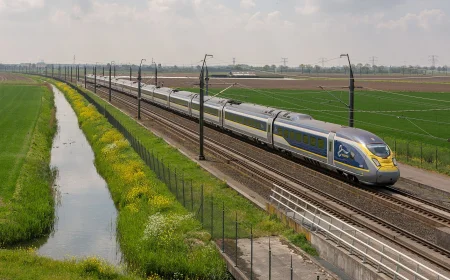
The first argument is interoperability. An early Thalys set had to carry up to seven signalling systems to link Paris, Brussels, Amsterdam and Cologne. With ERTMS, one onboard system is enough, which cuts the cost of trains and makes it easier for new operators to enter the market.
The second argument is capacity. With Level 2, blocks can be shorter than the spacing between signals, and the train receives an authority that is updated continuously. On the Paris–Lyon high-speed line, the busiest in France, SNCF Réseau aims to raise peak capacity from 13 to 16 trains per hour per direction by 2030, an increase of 25%, as part of an €820m project. The signalling changeover took 1,000 staff 101 hours in November 2024.
The third argument is maintenance: fewer lineside signals and cables in the long run, and the same equipment bought across Europe.
Why the rollout is so slow
The trans-European transport network (TEN-T) regulation, revised in 2024, sets completion of the core network for the end of 2030, the extended core network for the end of 2040 and the comprehensive network for the end of 2050, with ERTMS among the required equipment. The Commission's third ERTMS work plan, published in February 2026, admits progress is too slow: about 10% of the network and 19% of the fleet (8,730 vehicles) were fitted at the end of 2024.
Three obstacles explain the delay. Both track and trains must be fitted, and neither side has an incentive to move faster than the other. The specifications have changed several times (Baselines 2 and 3, then the 2023 TSI), forcing updates to recent equipment; in 2026 the European Union Agency for Railways (ERA) admitted mistakes and proposed freezing the specifications for several years. And the bill is heavy: the Netherlands has set aside €1.9bn for its programme, while Italy relied on EU recovery funds to fit 1,400 km.
Where Britain, France and the rest of the world stand
Britain pioneered ETCS Level 2 on the Cambrian Line in Wales, then combined Level 2 with automatic train operation on the Thameslink core in London, and is now fitting the southern end of the East Coast Main Line through the East Coast Digital Programme. France, whose TVM cab signalling arrived with the first high-speed line in 1981, first fitted its newer high-speed lines with Level 2, keeping TVM as a fallback on the LGV Est, and is now tackling its busiest existing lines, starting with Paris–Lyon. Outside Europe, ETCS has become a de facto standard: Morocco uses it on its Al Boraq high-speed line, Australia has made it mandatory for all future digital signalling on its national interoperable network, and Canada's Alto project plans it for its future trains.
We follow every step in our ERTMS / ETCS news section, including the Netherlands' €1.9bn ERTMS budget, the Welshpool ETCS incident, Italy's 1,400 km milestone, the Channel Tunnel upgrade and Germany's corridor renewals.
Frequently asked questions
What is the difference between ERTMS and ETCS?
ERTMS is the complete system. ETCS is its train protection part, which calculates movement authorities and supervises speed; GSM-R, soon FRMCS, is the radio part.
Does ERTMS remove lineside signals?
Not at Level 1, where signals stay. At Level 2, fitted lines have no lineside signals, only stop markers: the driver gets all the information in the cab, on the display. The standard does allow signals to be kept during a transition period.
Does ERTMS increase capacity?
Yes, mainly at Level 2, thanks to shorter blocks and continuous information. The gain depends on the line: SNCF Réseau expects 25% more peak capacity on Paris–Lyon by 2030.
What is a Eurobalise?
A passive unit fixed between the rails that sends the train its position and line data as it passes over.
When will all of Europe be fitted?
The EU timetable targets the core network by the end of 2030 and the whole trans-European network by the end of 2050. At the pace seen at the end of 2024, the Commission itself considers these deadlines hard to meet.
Sources: European Commission, ETCS Levels and Modes (accessed 24/10/2026); European Commission, Third ERTMS Work Plan (23/02/2026); EUR-Lex, summary of Regulation (EU) 2024/1679 on TEN-T; SNCF Group, ERTMS operation on Paris–Lyon (November 2024).
Written with AI assistance from the official sources cited, checked and approved by our international expert. Real photo, credited below the image. Spotted an error? contact@trainsnews.com — Our AI policy
Whats your reaction
 Like
0
 Dislike
0
 Love
0
 Funny
0
 Wow
0
 Sad
0
 Angry
0

TrainsNews est un média indépendant et bilingue d'actualité ferroviaire mondiale, publié depuis 2024. La rédaction couvre la grande vitesse, le matériel roulant, l'infrastructure, la signalisation et les télécoms ferroviaires (ERTMS/ETCS, CBTC, FRMCS, GSM-R), l'exploitation, le fret et le financement des projets. Chaque article cite ses sources et donne les chiffres avec leur total. TrainsNews is an independent, bilingual (French/English) news outlet covering the global rail industry since 2024: high-speed rail, rolling stock, infrastructure, signalling and telecoms, operations, freight and project financing. Every article cites its sources.





Comments (0)