

Beijing to Shanghai by high-speed train: times, fares, booking (2026)
Beijing to Shanghai in 4 h 18 by G train at 350 km/h, from about ¥626 in second class. Stations, seat classes, booking on 12306 with a foreign passport, visa-free transit, luggage and the CR450.
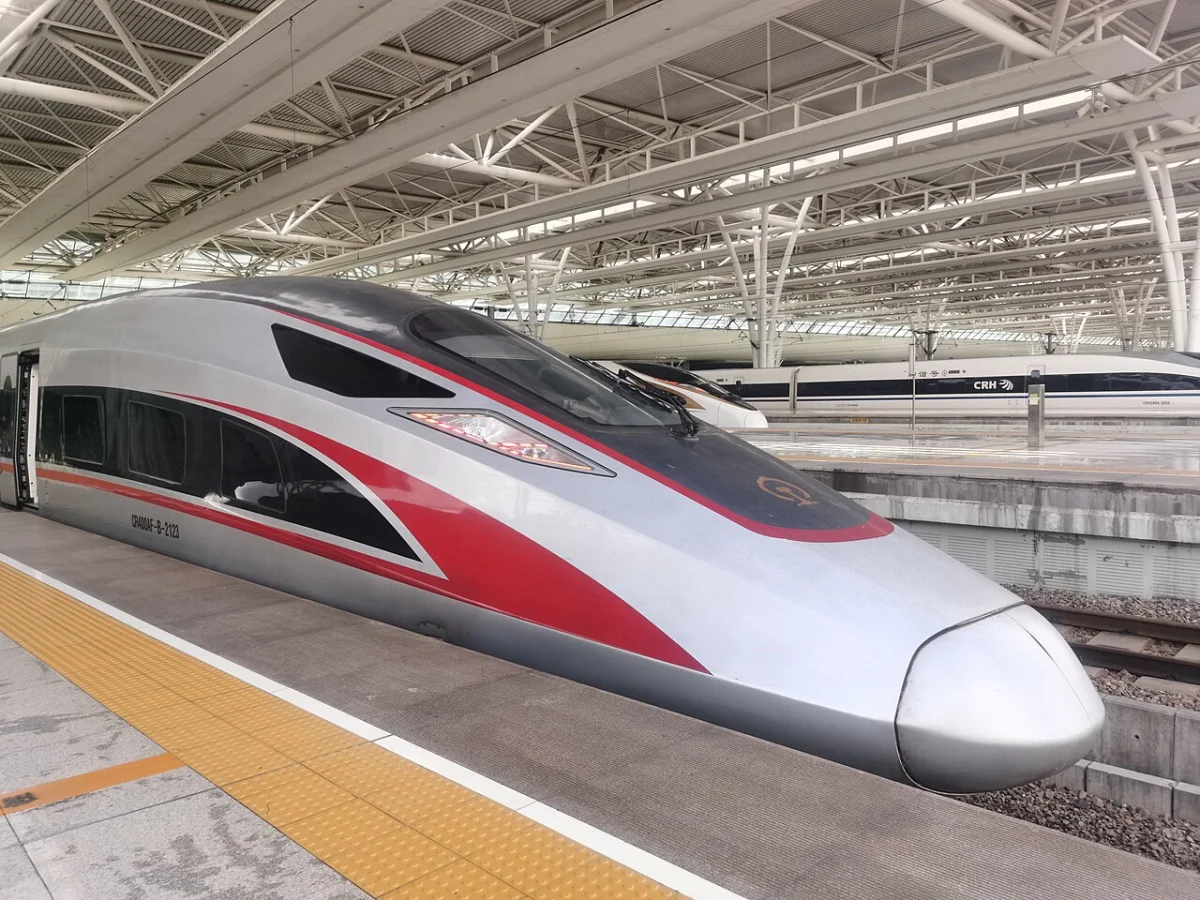
By the TrainsNews rail expert · updated 17 October 2026
Beijing to Shanghai is China's flagship high-speed rail route. The Beijing–Shanghai high-speed railway is 1,318 km long, opened on 30 June 2011 and has carried more than 2.3 billion passenger trips in 15 years, according to China Railway Beijing Group. The fastest G train covers the distance in 4 h 18 at up to 350 km/h on board a Fuxing train, and a second-class seat costs roughly ¥626 to ¥695 (about US$93 to US$104). Here is everything you need to know, from booking with a foreign passport to the coming 400 km/h CR450.
Beijing to Shanghai at a glance
| Item | Details |
|---|---|
| Operator | China State Railway Group (China Railway) |
| Line | Beijing–Shanghai high-speed railway, 1,318 km, opened 30 June 2011, 24 stations |
| Fastest train | G train, 4 h 18 (most take about 4 h 30 to 6 h) |
| Frequency | About 40 to 50 G trains a day in each direction, from early morning to about 21:30 |
| Main stations | Beijing South and Shanghai Hongqiao (a few trains use Beijing and Shanghai main stations) |
| Trains | Fuxing CR400AF and CR400BF, top speed 350 km/h |
| Fares (adult, one way, indicative) | Second class ¥626–695; first class ¥1,035–1,111; business class ¥2,158–2,318 |
| Overnight option | D sleeper trains, about 12 hours |
G train or sleeper?
G trains are the high-speed services and the obvious choice for most travellers. Journey times range from 4 h 18 on the fastest services to about 6 hours on trains with more stops, such as Jinan, Nanjing or Suzhou. Since prices only vary slightly between trains, it is worth picking one with fewer stops.
D sleeper trains (sleeper EMUs) run overnight in about 12 hours, typically leaving between about 19:00 and 21:30 and arriving around 07:30 to 09:30. You save a hotel night and arrive in the city centre in the morning. Second-class sleepers have six berths without a door; first-class sleepers have lockable four-berth compartments. Some sleepers use Beijing main station and Shanghai main station, or Shanghai Songjiang, so check the station on your ticket.
Stations and connections
- Beijing South (Beijingnan): the line's main Beijing terminus, used by almost all G trains, about 6 km south of Tiananmen Square and served by the metro.
- Beijing main station: in the city centre, used by a handful of G trains and by overnight sleepers.
- Shanghai Hongqiao: the terminus for most trains, about 18 km west of central Shanghai, next to Hongqiao Airport and linked to the metro.
- Shanghai main station: central, used by a small number of G trains and some sleepers.
Fares and seat classes
| Ticket (adult, Beijing–Shanghai, indicative) | Price |
|---|---|
| Second class | ¥626–695 (about US$93–104) |
| First class | ¥1,035–1,111 (about US$154–166) |
| Premium first class (selected 17-car trains) | ¥1,215–1,422 (about US$181–212), 2024 prices |
| Business class (meal included) | ¥2,158–2,318 (about US$322–346) |
| Overnight sleeper, second class (six berths) | From about ¥560 (about US$83) |
| Overnight sleeper, first class (four berths) | From about ¥730 (about US$109) |
Fares on this line have floated since December 2020: the price depends on the train, the time of day and demand, within a set range. Busy trains on Fridays, Sundays and holidays cost more. US dollar figures use a rate of about 6.71 yuan per dollar (September 2026) and are indicative only. Premium first class, introduced in June 2024, offers shell-shaped seats that rotate so that groups can face each other.
Booking as a foreign visitor
- 12306 (English website and app): the official China Railway booking system. You register with your passport and complete an identity check before buying, either automatically or by uploading a photo of your passport page. Foreign bank cards are accepted online. Verification can take time, so register before your trip.
- Trip.com: sells the same tickets in English at the 12306 fare with no booking fee, according to China for Travelers, accepts foreign Visa and Mastercard cards and is often easier for a first trip.
- When to book: tickets generally go on sale up to 15 days before departure. Book as soon as sales open for public holidays such as the Spring Festival, May Day and the October Golden Week.
- Name and passport: the name and passport number on the booking must match your passport exactly. Tickets are electronic; your passport is your ticket.
Visa-free travel and the train
China's 240-hour visa-free transit (10 days) is open to citizens of 55 countries, including the United States, arriving through 65 ports, including Beijing Capital, Beijing Daxing, Shanghai Pudong and Shanghai Hongqiao. You need an onward ticket to a third country or region, and travel between provinces in the eligible areas is allowed, which makes a Beijing–Shanghai rail trip possible within the 10 days. Holders of ordinary passports from France, Germany, Italy, Spain, the United Kingdom, Canada and other countries can also enter visa-free for up to 30 days until 31 December 2026. Check the latest rules before you travel.
Luggage and life on board
- Security and ID checks: bags are X-rayed at the station entrance and your passport is checked at the gate. According to China's Ministry of Culture and Tourism, passport holders should use the manual verification channel rather than the automatic gates. Arrive at least 30 minutes before departure.
- Luggage: the free allowance is 20 kg per adult (10 kg per child), and on high-speed trains each bag's length, width and height must not exceed 130 cm in total, according to independent travel guides. In practice bags are rarely weighed.
- Food: Fuxing trains have a buffet counter and a trolley service. You can also pre-order meals in the Railway 12306 app at least one hour ahead, or scan the QR code on your seat with WeChat. Business class includes a hot meal and drinks.
- Wi-Fi and data: newer Fuxing trains have Wi-Fi, but logging in usually requires a code sent to a Chinese mobile number. A local SIM or eSIM data plan is more reliable.
The future: the CR450 at 400 km/h
The next generation of Chinese high-speed train, the CR450, is designed to run at 400 km/h in commercial service, 50 km/h faster than today's Fuxing. Two prototypes rolled out at the end of 2024; in testing a single train reached 453 km/h and two trains passed each other at a combined 896 km/h. In March 2026, China State Railway Group said the trains had passed their type tests and completed 300,000 km of operational assessment, with design finalisation expected in 2026. No date has been announced for commercial service, nor officially for which line will get it first. At 400 km/h, a non-stop Beijing–Shanghai journey could not take less than about 3 h 20, even in theory.
An expert's view
The Beijing–Shanghai line was built from the outset for high speed and runs under CTCS-3, the Chinese train control system that uses radio (GSM-R) to send movement authorities to the train, in a similar way to ETCS Level 2 in Europe. It allows a minimum headway of about three minutes, which is what makes 40 to 50 end-to-end G trains a day possible alongside the many shorter services sharing the line. Much of the route is on viaduct, including the 164 km Danyang–Kunshan Grand Bridge, which keeps the alignment straight and level.
The step to 400 km/h is not only about the train. China's National Railway Administration says the new 15th Five-Year rail science and technology plan calls for matching track, bridges, tunnels, power supply and signalling. Higher speeds mean longer braking distances, so signalling blocks, power supply and maintenance windows all have to be reassessed before the CR450 can run at full speed in daily service.
Frequently asked questions
How long is the train from Beijing to Shanghai?
4 h 18 on the fastest G train; most G trains take about 4 h 30 to 6 hours. Overnight D sleepers take about 12 hours.
How much is the train from Beijing to Shanghai?
About ¥626 to ¥695 (US$93 to US$104) in second class, ¥1,035 to ¥1,111 in first class and ¥2,158 to ¥2,318 in business class. Fares vary by train and demand.
Can foreigners book on 12306?
Yes. The 12306 website and app are available in English; register with your passport, complete the identity check and pay with a foreign bank card. Trip.com is an alternative.
How far in advance can I book?
Tickets generally go on sale up to 15 days before departure. Book early for weekends and public holidays.
Which station should I use?
Beijing South and Shanghai Hongqiao for almost all G trains. Check your ticket, as a few trains and most sleepers use the main Beijing and Shanghai stations.
When will the 400 km/h CR450 run?
There is no official date. China State Railway Group expects the design to be finalised in 2026.
Key takeaways
- Beijing to Shanghai in 4 h 18 to about 6 hours by G train, with about 40 to 50 trains a day each way.
- Second class costs about ¥626–695; book on 12306 or Trip.com up to 15 days ahead with your passport.
- Allow 30 minutes for security and passport checks, and keep each bag within 130 cm (length + width + height).
Read also
- Tokyo to Osaka by Shinkansen: Nozomi, fares and JR Pass
- Seoul to Busan by KTX
- Whoosh: Jakarta to Bandung high-speed train
- All our train travel guides
For rail enthusiasts
T-shirts, mugs and posters for train lovers: visit the TrainsNews Store.
Sources: Macau Business, China Railway Beijing Group data on 15 years of the line (July 2026); China Daily HK, CR450 tests and design finalisation (9 March 2026); CCTV News, National Railway Administration 15th Five-Year plan (12 October 2026); Railway Gazette, Fuxing enters service (28 June 2017); CGTN, Beijing–Shanghai at 350 km/h (21 September 2017); Shanghai government / China Daily, premium first class (18 June 2024); Ministry of Culture and Tourism, train tickets for foreigners (14 April 2026); Hunan government, buying train tickets as a foreigner (June 2026); Shanghai government / CCTV, ordering food on trains (March 2025); Beijing government, 240-hour visa-free transit (5 November 2025); China for Travelers, Beijing to Shanghai fares and timetable (12 August 2026); seat61, Beijing to Shanghai by train; FRED, yuan to US dollar rate (September 2026). Information checked on 17 October 2026.
Photo: Shwangtianyuan, CC BY-SA 4.0, via Wikimedia Commons
Written with AI assistance from the official sources cited, reviewed by the TrainsNews editorial team. Real photo, credited below the image. Spotted an error? contact@trainsnews.com — Our AI policy
Whats your reaction
 Like
0
Like
0
 Dislike
0
Dislike
0
 Love
0
Love
0
 Funny
0
Funny
0
 Wow
0
Wow
0
 Sad
0
Sad
0
 Angry
0
Angry
0

TrainsNews est un média indépendant et bilingue d'actualité ferroviaire mondiale, publié depuis 2024. La rédaction couvre la grande vitesse, le matériel roulant, l'infrastructure, la signalisation et les télécoms ferroviaires (ERTMS/ETCS, CBTC, FRMCS, GSM-R), l'exploitation, le fret et le financement des projets. Chaque article cite ses sources et donne les chiffres avec leur total. TrainsNews is an independent, bilingual (French/English) news outlet covering the global rail industry since 2024: high-speed rail, rolling stock, infrastructure, signalling and telecoms, operations, freight and project financing. Every article cites its sources.









Comments (0)