

France's summer of 1985: three rail crashes, 95 dead
Three rail accidents killed 95 people in France between 8 July and 31 August 1985. Sourced tolls, causes, and what SNCF changed afterwards: cab radio, CAPI and KVB.
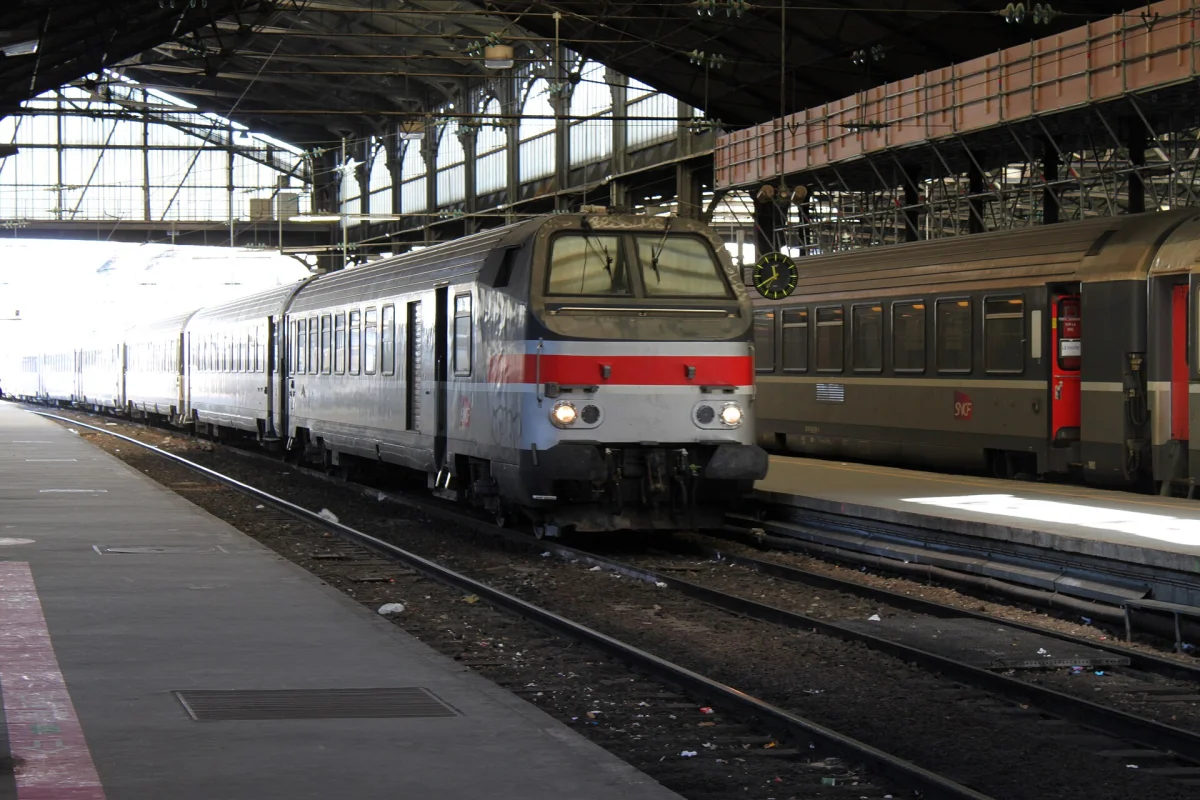
Three rail accidents killed 95 people in France between 8 July and 31 August 1985, at Saint-Pierre-du-Vauvray, Flaujac and Argenton-sur-Creuse. Each had a different cause, yet together they forced SNCF to rethink how it protected trains, from cab radio to automatic speed supervision.
The figure of 95 deaths comes from France's national broadcasting archive, the INA, which calls 1985 the darkest year in French railway history. It is the sum of three separate tolls: 17, 35 and 43. On the day of the third crash, transport minister Jean Auroux said three accidents in one year were "three too many" and ordered SNCF to put safety awareness first across its workforce. On 10 September the company's chairman, André Chadeau, resigned. He was replaced by Philippe Essig, who led SNCF until 1988 according to the operator's official list of past chairmen.
Saint-Pierre-du-Vauvray, 8 July: a lorry trapped on a level crossing
The first crash happened in Normandy, in the Eure department, on the Paris–Le Havre line. A Corail express hit a lorry on a level crossing and derailed at high speed. The official toll, given by the INA and by regional broadcaster France 3 Normandie, was 17 dead and 99 injured. The INA notes that the inquiry found no technical fault with the crossing equipment.
Removing the crossing took a long time. The Eure departmental council, France 3 reports, only voted in 2003 to fund an underpass and close the crossing, a scheme costing more than €21 million and shared between the department, the state, the region, the town and the then infrastructure manager Réseau ferré de France. By 2017, around 155 trains and 3,300 cars passed through the village each day. The eighteen-year gap between the crash and the works shows how slow and costly it is to close a busy crossing.
Flaujac, 3 August: head-on on a single-track line
Less than a month later, in the Lot department of south-west France, a Rodez–Brive railcar and a Corail train from Paris met on a single-track section near Flaujac. According to France 3 Occitanie, each was travelling at about 120 km/h. Thirty-five people died, a figure given by both the INA and France 3. France 3 puts the number of injured at "around a hundred"; the INA gives no figure.
The failure lay in how the line was worked. Trains on such routes crossed at stations under an arrangement agreed by telephone between station staff. The railcar, France 3 says, was cleared to leave even though the Corail was coming the other way. A news report from the time, quoted by the INA, suggested that the stationmaster at the small station of Assier may have confused the weekday timetable with the Saturday one and forgotten that the trains were due to pass at his station. Once the railcar had left, there was no way to warn either driver. The same report pointed out that ground-to-train radio covered only a tenth of French lines and played no part in safety.
Argenton-sur-Creuse, 31 August: a derailment, then the mail train
The deadliest of the three is described in detail by the Indre fire and rescue service, which led the response. At around 00:08, a 14-coach Paris–Port-Bou overnight train, with six sleeper and couchette cars and 450 people on board, ran through Argenton at 100 km/h. Track work had weakened the ballast and the limit there was 30 km/h. The driver made an emergency brake application, but ten coaches came off on a canted curve and two of them fouled the adjacent line.
The Brive–Paris mail train was approaching on that line at 100 km/h, with no restriction in force. The fire service says its driver, blinded by dust and smoke, braked but could not stop in time. A local resident raised the alarm at 00:10, the first crews arrived at 00:14 and the ORSEC civil emergency plan was activated at 00:30. More than 250 firefighters from the Indre and six neighbouring departments worked through the night, and the last injured passenger was freed at about 07:00. By the evening of 31 August the toll stood at 43 dead and 40 injured, according to the fire service; the INA also gives 43 deaths.
The three accidents had little in common on the surface: a lorry stuck on a crossing, a train crossing arranged wrongly by phone, a temporary speed restriction ignored. What linked them was that, each time, a single human error or obstruction was not caught by any technical system.
What changed afterwards: radio, computer-assisted block and KVB
Cab radio was the most visible change. Writing in the journal Flux, historian Jean-Emmanuel Terrier shows that SNCF commissioned several hundred kilometres of ground-to-train radio a year until the mid-1990s, with peaks of more than a thousand kilometres in some years, notably after the serious accidents of the late 1980s. Coverage rose from 3,000 km in 1985 to 4,200 km a year later and more than 8,000 km four years after that. By September 1990 every electric locomotive, TGV and electric multiple unit was fitted.
On single-track lines, the answer was software. A training document from the French rail safety authority, EPSF, states that passenger single-track lines were equipped with computer-assisted block working, known as CAPI, following the Flaujac accident. It replaced the telephone exchanges between staff, the very procedure that broke down at Flaujac. The version the EPSF describes, CAPI 95, was launched in 1995.
KVB, the French balise-based speed supervision system, traces back to Argenton. A 2008 review by the Conseil général des ponts et chaussées, a government inspectorate, says that after the Argenton-sur-Creuse and Noveant accidents SNCF decided to test a Swedish speed-control system, trialled on Paris–Le Havre from 1987 to 1989. The board approved a full programme in early 1990. The first stage was finished in 1995 for the track and 2002 for the trains, against targets of 1993 and 1995, and the second stage in 2006.
Those dates carry their own lesson. CAPI 95 arrived ten years after Flaujac, and KVB was complete twenty-one years after Argenton. A safety decision taken under public pressure only protects passengers once the equipment is installed along the whole line and in every cab. For the wider picture of later crashes and their consequences, see our list of high-speed train accidents and what changed.
Frequently asked questions
How many people died in France's rail accidents of summer 1985?
95 in total according to the INA: 17 at Saint-Pierre-du-Vauvray on 8 July, 35 at Flaujac on 3 August and 43 at Argenton-sur-Creuse on 31 August.
Which 1985 accident led to KVB?
According to the Conseil général des ponts et chaussées, SNCF decided to test balise-based speed control after the Argenton-sur-Creuse and Noveant accidents, with trials running from 1987 to 1989.
Sources: INA, "1985 : année noire pour la SNCF", 21 January 2026; France 3 Normandie, 15 December 2017; France 3 Occitanie, 3 August 2015; SDIS de l'Indre, history page; J.-E. Terrier, "La radio sol trains à la SNCF (1976-2002)", Flux no. 54, 2003; EPSF training document, 5 July 2017; CGPC review of KVB, March 2008; SNCF, past chairmen. Lire en français : l'été noir 1985 du rail français.
Photo: Corail B6Dux driving trailer at Paris Saint-Lazare, 27 February 2010 (illustration: Paris–Le Havre line stock in normal service) — Nogwai, Wikimedia Commons, CC0.
Article written with the help of artificial intelligence from the sources cited, and reviewed by the TrainsNews editorial team before publication.
Whats your reaction
 Like
0
 Dislike
0
 Love
0
 Funny
0
 Wow
0
 Sad
0
 Angry
0

TrainsNews est un média indépendant et bilingue d'actualité ferroviaire mondiale, publié depuis 2024. La rédaction couvre la grande vitesse, le matériel roulant, l'infrastructure, la signalisation et les télécoms ferroviaires (ERTMS/ETCS, CBTC, FRMCS, GSM-R), l'exploitation, le fret et le financement des projets. Chaque article cite ses sources et donne les chiffres avec leur total. TrainsNews is an independent, bilingual (French/English) news outlet covering the global rail industry since 2024: high-speed rail, rolling stock, infrastructure, signalling and telecoms, operations, freight and project financing. Every article cites its sources.
The rail month in one PDF: news and guides summarised, with their photos.
The rail month in one PDF: news and guides summarised, with their photos.


Comments (0)