

Santiago de Compostela train crash (2013): the signalling gap
Alvia train 150/151 ran past the end of the ERTMS-equipped section of the Ourense–Santiago line at 200 km/h and derailed at 179 km/h in the 80 km/h Angrois curve on 24 July 2013. What the CIAF found, and what Spain changed.
Lire en français : Accident de Saint-Jacques-de-Compostelle (2013) : faits et leçons
By the TrainsNews editorial team · Updated 2 November 2026
The Santiago de Compostela derailment of 24 July 2013 happened about 4 km beyond the end of the ERTMS-equipped section of the Ourense–Santiago line. Alvia train 150/151 entered the 80 km/h Angrois curve at 179 km/h; Spain's rail accident investigation commission (CIAF) recorded 80 deaths.
| Date | Wednesday 24 July 2013, 20:41 |
| Location | Line 082 Ourense–Santiago, km 84+413, Angrois district, 3.6 km from Santiago de Compostela station |
| Train | Renfe service 150/151 Madrid-Chamartín–Ferrol, 13-vehicle Class 730 Alvia set |
| Signalling | ERTMS/ETCS Level 1 towards Santiago from km 1+845 to km 80+069; ASFA along the whole line |
| Speed | 179 km/h at derailment; curve radius 402 m, limit 80 km/h |
| Toll | 80 dead (CIAF); the courts count 79 homicides and 143 injured |
The CIAF final report, signed on 20 May 2014, names the cause as excessive speed: the driver did not comply with the timetable book and the line's maximum speed table. It adds a contributing factor. A service call from the train manager on the driver's company phone distracted him, so he did not brake in time.
Two systems on board, one in use
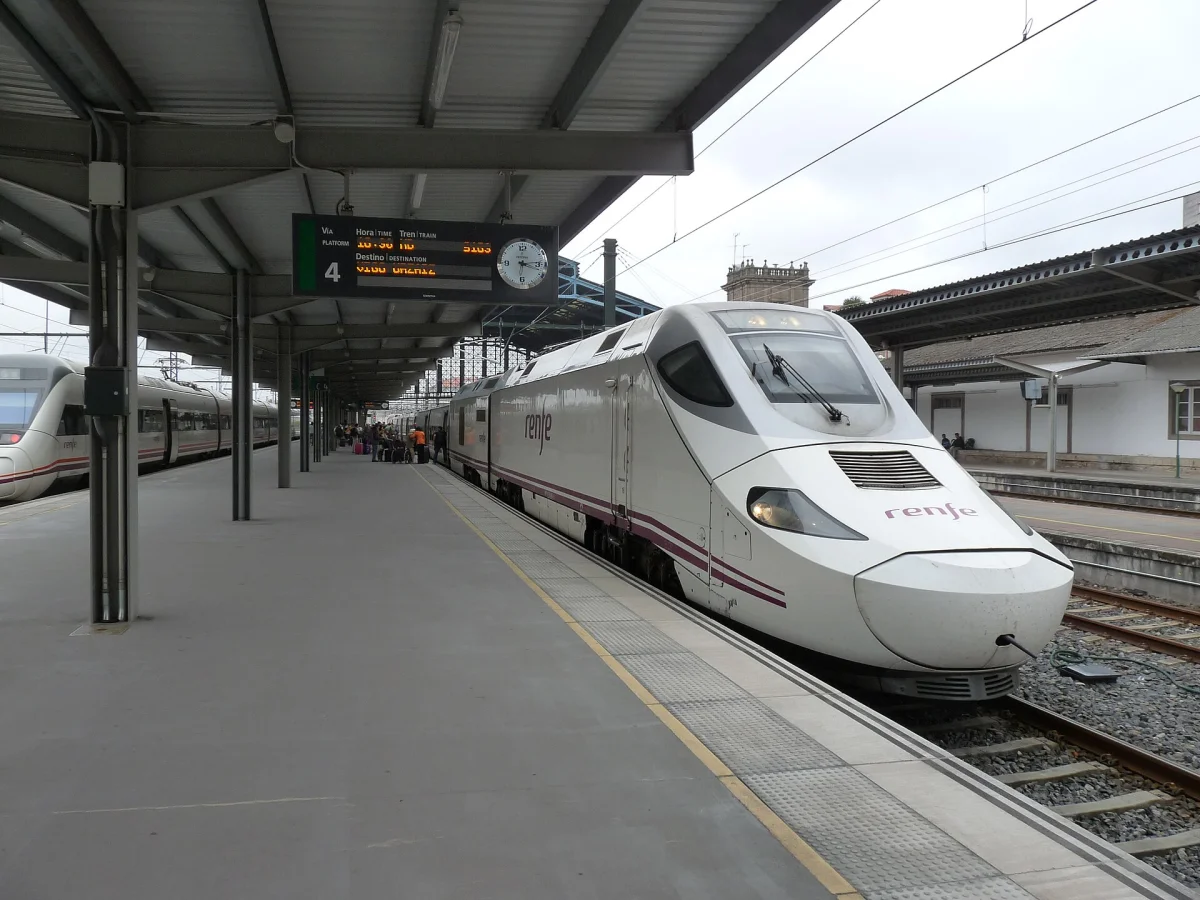
The Class 730 carries both ERTMS/ETCS and ASFA Digital, Spain's national train protection system. According to the CIAF, Renfe asked shortly after the line opened to run these units on lineside signals under ASFA Digital, citing reliability and availability problems with their ERTMS configuration on line 082. Adif, the infrastructure manager, agreed. In that mode the Class 730 was limited to 200 km/h, roughly the speed at which the train ran along the line that evening.
Even with ERTMS in use, continuous supervision would have stopped well short of the curve: towards Santiago, the ERTMS section ended at km 80+069, and the curve begins at km 84+228. The driver took the call around km 78+280, about 6 km before the curve. He passed the distant signal E'7 at km 80+619 at almost 200 km/h, showing clear because the straight route was set. He had told the investigating judge that this was where he normally began to slow down. The last sound of the call was recorded 100 seconds after it started, near home signal E7 at km 84+176. Emergency braking began there, at 195 km/h, only 52 m before the curve.
For a signalling team, the lesson is about where protection ends. The train left the ERTMS section at line speed with a drop from 200 to 80 km/h ahead, and every signal on the approach showed clear. The CIAF's finding rests on the driver's compliance with the timetable book and the speed table, which shows how much depended on one person's attention at that point. A phone call took it away.
375 speed changes reviewed
The CIAF's first two recommendations went to Adif: fixed lineside signs for every speed reduction above a set threshold, and, for large reductions, balises that brake the train if it is about to exceed the next limit, with further development of ASFA Digital to make that possible. Others asked the safety authority for a specific risk analysis when new lines open, covering interfaces between subsystems, rules to keep phone calls with drivers safe, and audio recording in driving cabs.
Some work started before the report was finished. Spain's public works minister announced 20 measures on 9 August 2013. By March 2014, the CIAF reports, Adif had identified 375 "significant speed changes" on its network, 51 of them on high-speed lines, and had fitted warning signs and ASFA balises at the 122 sharpest ones. A prototype ASFA balise with 11 frequencies instead of five was in trackside testing, and the scheduled transitions between ERTMS Level 1 and ASFA had been reviewed.
The courts reached a final decision in 2026. On 23 January the provincial court of A Coruña upheld the driver's sentence of two years and six months, and acquitted Adif's former head of traffic safety, who had been convicted at first instance, according to Spain's General Council of the Judiciary. The court found he had no decision-making power over ERTMS. One judge dissented. No further appeal to the Supreme Court is possible.
Angrois sits among the deadliest entries in our list of high-speed train accidents. Spain's investigators are now looking at another high-speed crash, the AVE and Iryo collision at Urda.
Frequently asked questions
How many people died in the Santiago de Compostela train crash?
The CIAF report counts 80 deaths. The court rulings refer to 79 homicides through gross negligence and 143 people injured.
Why was ERTMS not protecting the Angrois curve?
Towards Santiago, ERTMS ended at km 80+069, about 4 km before the curve. The Class 730 also ran on that line under ASFA Digital, at Renfe's request and with Adif's approval.
What changed after the crash?
By March 2014, Adif had fitted warning signs and ASFA balises at 122 sharp speed reductions, according to the CIAF, which also called for cab audio recording and safer phone rules for drivers.
Sources: CIAF, final report on serious accident 0054/2013 (20 May 2014, copy published by ERA); General Council of the Judiciary, ruling of the provincial court of A Coruña (23 January 2026). Checked on 2 November 2026.
Photo: Santiago de Compostela station, 15 August 2015. Smiley.toerist, CC BY-SA 4.0, via Wikimedia Commons
Written with AI assistance from the sources cited, reviewed by the TrainsNews editorial team. Real photo, credited below the image. Spotted an error? contact@trainsnews.com — Our AI policy
Whats your reaction
 Like
0
 Dislike
0
 Love
0
 Funny
0
 Wow
0
 Sad
0
 Angry
0

TrainsNews est un média indépendant et bilingue d'actualité ferroviaire mondiale, publié depuis 2024. La rédaction couvre la grande vitesse, le matériel roulant, l'infrastructure, la signalisation et les télécoms ferroviaires (ERTMS/ETCS, CBTC, FRMCS, GSM-R), l'exploitation, le fret et le financement des projets. Chaque article cite ses sources et donne les chiffres avec leur total. TrainsNews is an independent, bilingual (French/English) news outlet covering the global rail industry since 2024: high-speed rail, rolling stock, infrastructure, signalling and telecoms, operations, freight and project financing. Every article cites its sources.
The rail month in one PDF: news and guides summarised, with their photos.
The rail month in one PDF: news and guides summarised, with their photos.





Comments (0)