

Rail 2026: the end of wires everywhere
Battery trains, catenary islands and discontinuous electrification are replacing full overhead wiring on secondary lines, while hydrogen loses ground.
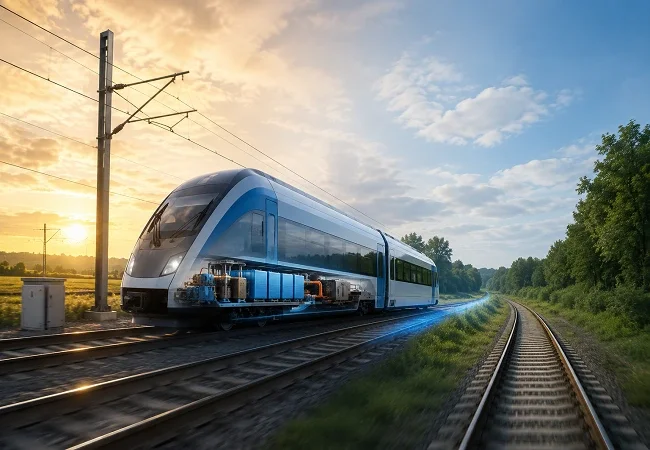
For decades, running electric trains on a secondary line meant installing overhead wires along its full length. That assumption has now weakened. Battery-electric multiple units (BEMUs) are in daily service in Germany and the UK. Electrification projects in Wales deliberately leave gaps in the overhead line. New Zealand has ordered a battery fleet for its Wellington regional lines. Hydrogen, meanwhile, has run into reliability and cost problems. The result in 2026 is a mixed model: catenary where traffic justifies it, plus short wired "islands" and on-board energy storage everywhere else.
Battery trains move from prototype to fleet
In December 2021 a three-car FLIRT Akku covered 224 km between Berlin and Warnemünde on battery power alone, a Guinness world record, in near-freezing conditions. Stadler had designed the train for an operational range of about 80 km.
Fleet service followed. In Schleswig-Holstein, the transport authority NAH.SH has ordered 55 two-car FLIRT Akku units. Service began on 1 October 2023 out of Kiel. The units charge from the existing 15 kV 16.7 Hz network and at stations with overhead line. To make battery operation possible, DB Netz spent €40 million on about 11 km of catenary islands so that no non-electrified section exceeded 80 km, according to Railway Gazette.
In Baden-Württemberg, SWEG put the first four of 27 Siemens Mireo Plus B units into service on the Ortenau network on 8 April 2024. These two-car, 120-seat trains have a stated battery range of up to 120 km. They charge under 15 kV overhead line and at charging points in Achern and Biberach. Siemens expects the fleet to save about 1.8 million litres of diesel a year, according to its press release.
Hydrogen loses ground in Germany
The Elbe-Weser operator EVB, which replaced diesel railcars with 14 Alstom Coradia iLint units, had only four in service by August 2025 because replacement fuel-cell modules had not been delivered. It had to bring diesel units back. Around Frankfurt, RMV withdrew iLints from the Taunus line RB15 after two years of unreliable operation and leased 16 diesel Lint 41s, with Alstom covering the cost.
In July 2023 the Lower Saxony authority LNVG concluded that batteries offered the lowest overall cost and chose BEMUs over hydrogen for 102 future trains, with services from 2029 using existing wires plus charging islands. In November 2025 Alstom paused its hydrogen research in France after state co-funding was withdrawn, with its chief executive describing the technology as "not yet mature", according to IRJ. Hydrogen still has supporters, notably in India, where the first hydrogen train entered service on the Jind–Sonipat line in July 2026.
Discontinuous electrification in Wales
The UK is applying the same idea on the infrastructure side. On the Cardiff Core Valley Lines, about 170 km of the 218 km network has been wired at 25 kV, according to Rail Engineer. Where old bridges or listed structures made overhead line too costly, engineers used two techniques. Permanently earthed sections let trains pass with the pantograph raised. Catenary-free sections require the pantograph to be lowered while the train runs on battery. Transport for Wales' Stadler Class 756 tri-mode units (2.6 MW on 25 kV, 1.3 MW on battery) and Class 398 tram-trains change power mode automatically, triggered by RFID beacons. On Merseyside, seven Class 777 units fitted with batteries have served the non-electrified extension to Headbolt Lane since October 2023.
Wellington: a full battery fleet
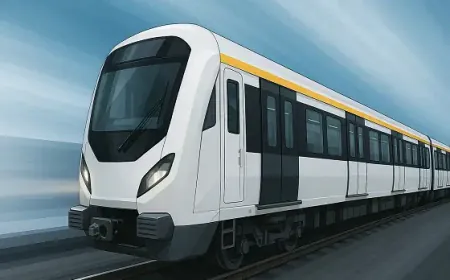
In September 2025 Greater Wellington chose Alstom for 18 five-car Adessia Stream B BEMUs, the Tūhono fleet, in a €538 million contract that includes 35 years of maintenance. The trains, built at Savli in India, will replace diesel locomotive-hauled stock on the Wairarapa and Manawatū lines from the end of the decade. They will run at up to 120 km/h (see our report on the contract).
An engineer's view: the infrastructure is the real project
Battery trains do not remove electrical infrastructure; they concentrate it. A charging island at 15 kV 16.7 Hz or 25 kV 50 Hz still needs a feeder, protection, sectioning and earthing, and often a new supply point or substation upgrade. The grid connection becomes the main planning risk. Charging time also has to fit the timetable: terminal dwell times become a design input, and a delayed train that misses part of its charge carries the deficit into its next run. In Wales, beacon-triggered pantograph changes add rolling stock–infrastructure interfaces that need assurance alongside the signalling. Battery ageing over a 30-year vehicle life also has to be costed from the start; for the Mireo Plus B, one battery replacement is expected over that period.
The trend points less to the end of wires than to more targeted use of them. More innovations of this kind are covered in our innovations section.
Sources: Railway News (Stadler), 22 December 2021; Railway Gazette, 2023–2024; Siemens Mobility, 8 April 2024; gasworld, 2025; H2 View, 2025; IRJ, 26 November 2025; Rail Engineer, 27 August 2025; Merseytravel, 5 October 2023; Alstom, 8 September 2025.
Whats your reaction
 Like
0
Like
0
 Dislike
0
Dislike
0
 Love
0
Love
0
 Funny
0
Funny
0
 Wow
0
Wow
0
 Sad
0
Sad
0
 Angry
0
Angry
0

TrainsNews est un média indépendant et bilingue d'actualité ferroviaire mondiale, publié depuis 2024. La rédaction couvre la grande vitesse, le matériel roulant, l'infrastructure, la signalisation et les télécoms ferroviaires (ERTMS/ETCS, CBTC, FRMCS, GSM-R), l'exploitation, le fret et le financement des projets. Chaque article cite ses sources et donne les chiffres avec leur total. TrainsNews is an independent, bilingual (French/English) news outlet covering the global rail industry since 2024: high-speed rail, rolling stock, infrastructure, signalling and telecoms, operations, freight and project financing. Every article cites its sources.

Comments (0)