



China 400 km/h: railway revolution in 2027
China to launch commercial 400 km/h trains by late 2026. Discover CR450 project revolutionizing global rail transport.
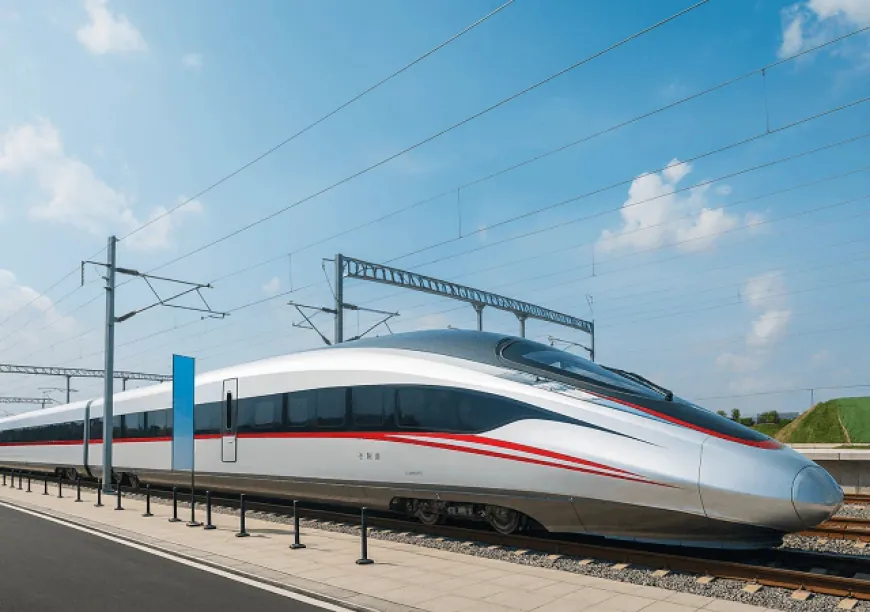
China prepares its railway revolution: destination 400 km/h
China Railway (CR) is set to reach a historic milestone with the commercial launch of 400 km/h trains by the end of 2026.
This groundbreaking announcement, unveiled at the 12th UIC World Congress on High-Speed Rail in Beijing, definitively positions the Middle Kingdom as the undisputed leader in global ultra-rapid mobility. This technical achievement marks a new era in the evolution of Chinese rail transport.
The meteoric expansion of China's high-speed network
Mind-boggling figures
Since the inauguration of the first Beijing-Tianjin line in 2008, China's high-speed rail network has experienced spectacular growth. With its current 48,000 kilometers, it now represents 70% of the world's high-speed rail network.
The target set for 2035 is even more ambitious: 70,000 kilometers of lines. This colossal expansion already connects 97% of cities with over 500,000 inhabitants, creating an unprecedented territorial network that directly competes with air transport on intercity routes.
Record operational performance
The Chinese railway transport system carries more than 16 million passengers daily thanks to a fleet exceeding 10,000 high-speed trains. This performance relies on a fully digitized ticketing system, ensuring fluidity and efficiency.
The evolution of commercial speeds perfectly illustrates this rise to power:
- Initially capped at 300 km/h after the 2011 Wenzhou accident
- Gradual return to 350 km/h on certain sections
- Imminent objective: 400 km/h commercial service
The CR450 project: engineering excellence for extreme speeds
Breakthrough technological innovation
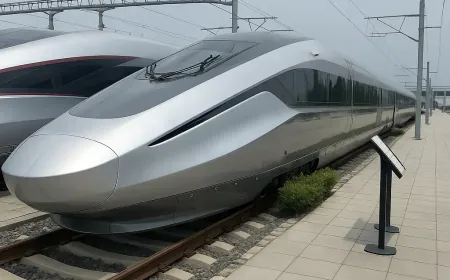
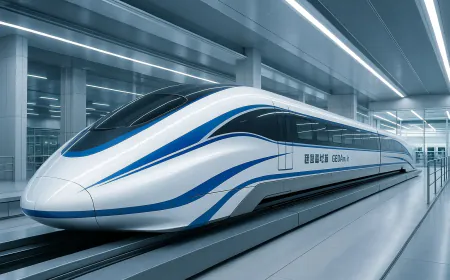
The CR450 project represents the spearhead of this new railway era. Unveiled in 2023, the next-generation prototypes CR450AF (CRRC Changchun) and CR450BF (CRRC Sifang) embody a revolutionary approach.
These innovative Chinese trains were designed "from scratch" and integrate:
- Optimized aerodynamics to reduce air resistance
- Extensive use of lightweight carbon fiber
- High-performance faired bogies
- Over 4,000 sensors for real-time monitoring
Exceptional trial performances
Tests on pilot lines have reached speeds of 453 km/h, with train crossings exceeding 890 km/h. These results confirm the technological maturity of the project and its ability to revolutionize Chinese high-speed rail.
Infrastructure and AI: pillars of ultra-high speed
Major infrastructural adaptations
To support these extreme speeds, significant railway modernizations are underway:
- Widened tunnel portals to optimize aerodynamics
- Optimization of ballast and welded joints
- Modernization of catenary and braking systems
- Integration of reinforced acoustic barriers
Artificial intelligence serving performance
China Railway is betting on AI for dynamic traffic management and demand prediction. This technological approach simultaneously improves operational efficiency and network safety.
China's vision for global railway leadership
Technological export ambitions
Beyond domestic success, China aims to export its railway expertise. In less than two decades, it has caught up with and surpassed historical foreign players.
The introduction of 400 km/h commercial services will consolidate CR's place in the history of world railway records, alongside the Shinkansen and TGV, inaugurating a new era of ultra-rapid mobility dominated by Chinese technology.
This Chinese railway revolution redefines global high-speed transport standards and paves the way for even more efficient and sustainable intercity mobility.
Whats your reaction
 Like
0
Like
0
 Dislike
0
Dislike
0
 Love
0
Love
0
 Funny
0
Funny
0
 Wow
0
Wow
0
 Sad
0
Sad
0
 Angry
0
Angry
0

TrainsNews


Comments (0)