

Turkey reopens 350 km railway along the Syrian border
Turkey reopened 350 km of railway along its border with Syria to trains on 31 March 2026, after rehabilitating the Karkamış–Nusaybin line and the Şenyurt–Mardin branch. Ankara presents it as a feeder for its Development Road to Iraq and a north–south corridor with Syria and Jordan.
Lire en français : La Turquie rouvre 350 km de voie ferrée le long de la Syrie
Turkey reopened 350 km of railway along its border with Syria to trains on 31 March 2026, after rehabilitating the Karkamış–Nusaybin line and the Şenyurt–Mardin branch. Ankara presents it as a feeder for its Development Road to Iraq and a north–south corridor with Syria and Jordan.
Transport and Infrastructure Minister Abdulkadir Uraloğlu announced the reopening on 13 April, saying maintenance that could not be carried out between 2011 and 2024 had now been completed, in a ministry statement. The 325 km Karkamış–Nusaybin line hugs the frontier from Gaziantep province to Mardin, and the 25 km branch links Şenyurt with the city of Mardin. Anadolu Agency, quoted by Daily Sabah, described the corridor as reopened to freight traffic.
The works went well beyond routine upkeep, according to the ministry. Track and station foundations were rebuilt, and at several stations the existing tracks were lifted and relaid. Crews reinforced 750 m of unstable ground, built culverts and drainage, and renewed more than 2,500 bridge sleepers across the line, as well as strengthening the Karkamış bridge over the Euphrates. No cost was given.
A border line with an Iraqi destination
The minister tied the line directly to the Development Road, a corridor meant to carry freight from the Persian Gulf to Europe through Iraq and Turkey. The Karkamış–Nusaybin and Mardin–Şenyurt lines "will support the Ovaköy–Nusaybin railway to be built under the Development Road project", he said. On 28 July, in the presence of President Recep Tayyip Erdoğan and the Iraqi prime minister, the two countries signed memoranda including one on rail and road transport through the Fişhabur–Ovaköy border crossing, Uraloğlu recalled at a conference on the project on 19 October 2026.
Syria features in a second, north–south plan. On 7 April 2026, Uraloğlu signed a transport cooperation memorandum with his Jordanian and Syrian counterparts at a ministerial meeting hosted by Jordan, covering road, rail, sea, air and multimodal links, the ministry said. He noted that the historic railways linking the three countries are not currently operational and argued for reviving the Hejaz Railway heritage alongside a new standard line. In October he said a Hejaz Railway cooperation memorandum had recently been signed with Saudi Arabia, describing a 2,511 km link that would include 1,681 km in Turkey, from Kapıkule through Istanbul and Eskişehir to İslahiye, plus sections in Syria, Jordan and Saudi Arabia.
What the reopening does and does not settle
The Turkish side of the border is now usable, but the corridor's capacity depends on figures Ankara has not published: line speed, permitted axle load and signalling after the works. Replacing bridge sleepers and treating drainage restores a line's basic geometry; it does not by itself make it ready for heavy, regular international freight. On the Syrian side, none of the official statements reviewed by TrainsNews gives a date for cross-border services.
Turkey's ministry expects the Development Road to add about 55 billion dollars to the economy over ten years and to create around 70,000 jobs a year. These are official projections, not results. Elsewhere on the network, Turkish investment continues on the high-speed side, including the British Steel rail contract for Ankara–İzmir.
The next step for the border corridor is the start of construction on the Ovaköy–Nusaybin link to the Iraqi frontier, for which the April statement gave no timetable.
Sources: Turkish Ministry of Transport and Infrastructure, reopening statement (13/04/2026); Turkish Ministry of Transport and Infrastructure, Turkey–Syria–Jordan memorandum (07/04/2026); Turkish Ministry of Transport and Infrastructure, Development Road conference (19/10/2026); Anadolu Agency via Daily Sabah (13/04/2026); International Railway Journal (April 2026).
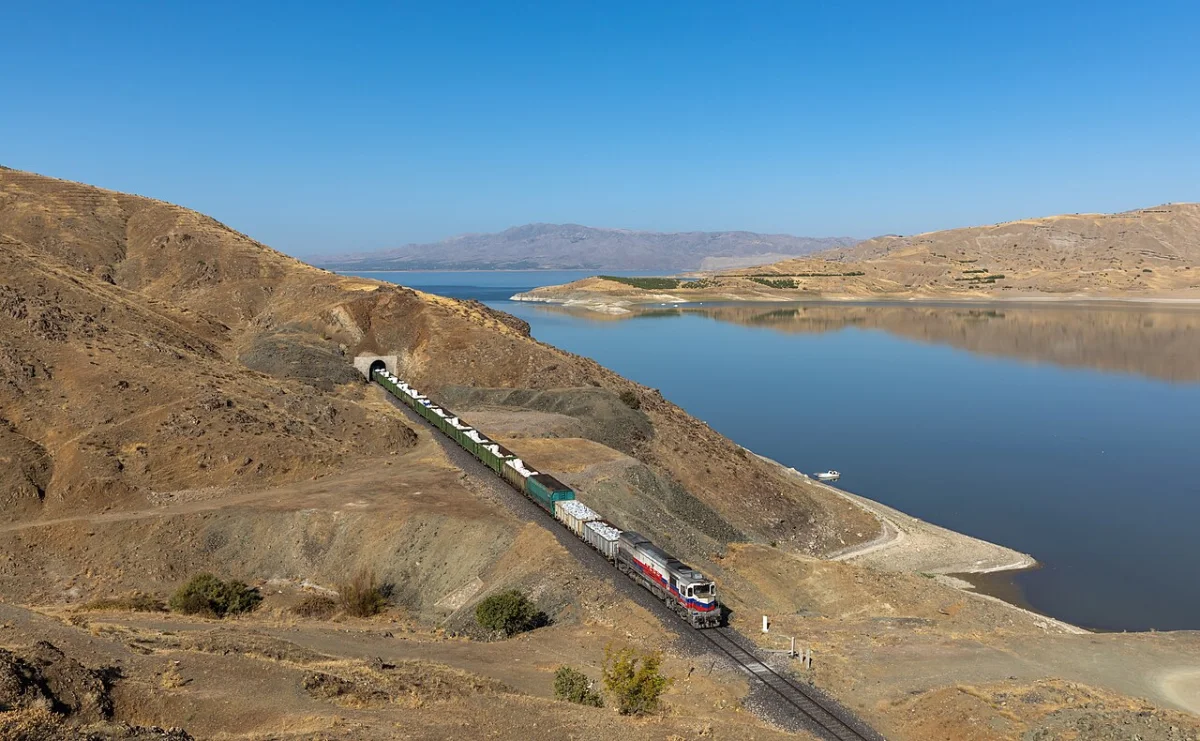
Photo: TCDD DE 33 075 with a freight train to Tatvan at the Keban reservoir, October 2022. Kabelleger / David Gubler, CC BY-SA 4.0, via Wikimedia Commons.
Article written with the help of AI from the sources cited above, reviewed by the TrainsNews editorial team. Real photo, credited below the image. Spotted an error? contact@trainsnews.com – Our AI charter
Whats your reaction
 Like
0
 Dislike
0
 Love
0
 Funny
0
 Wow
0
 Sad
0
 Angry
0

TrainsNews est un média indépendant et bilingue d'actualité ferroviaire mondiale, publié depuis 2024. La rédaction couvre la grande vitesse, le matériel roulant, l'infrastructure, la signalisation et les télécoms ferroviaires (ERTMS/ETCS, CBTC, FRMCS, GSM-R), l'exploitation, le fret et le financement des projets. Chaque article cite ses sources et donne les chiffres avec leur total. TrainsNews is an independent, bilingual (French/English) news outlet covering the global rail industry since 2024: high-speed rail, rolling stock, infrastructure, signalling and telecoms, operations, freight and project financing. Every article cites its sources.
The rail month in one PDF: news and guides summarised, with their photos.
The rail month in one PDF: news and guides summarised, with their photos.







Comments (0)