

Metra unveils Stadler battery train for Chicago's Rock Island Line
Metra has put the first of eight Stadler FLIRT battery-electric trains on display in Chicago. The four-car sets will replace diesel trains on the 16.4-mile Beverly Branch of the Rock Island Line, with passenger service expected in 2028 after a year of testing.
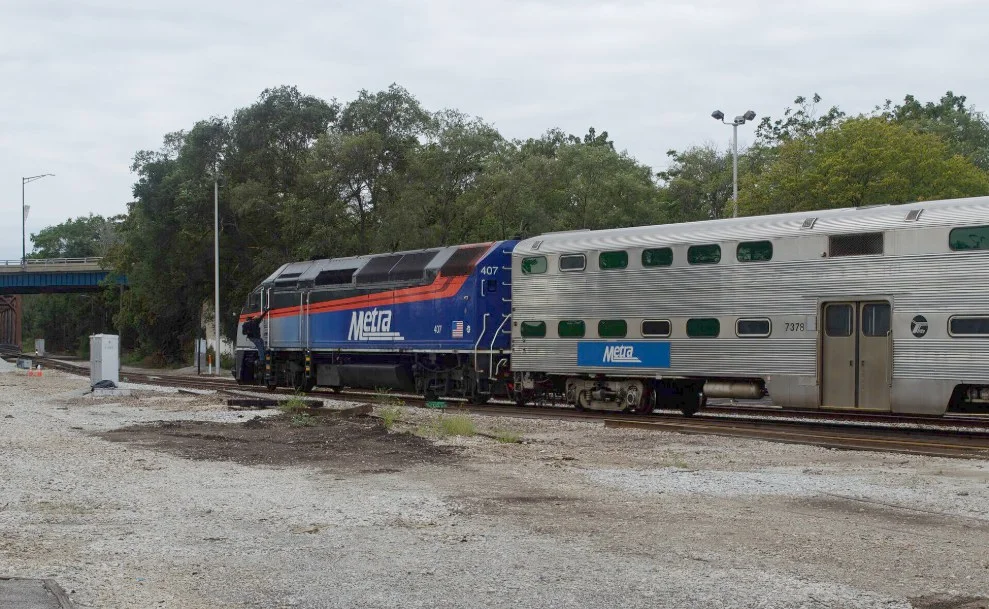
Chicago commuter operator Metra put the first of its eight Stadler battery-electric trains on public display at LaSalle Street Station on 14 and 15 October. The four-car FLIRT sets are due to replace diesel trains on the 16.4-mile (26 km) Beverly Branch of the Rock Island Line, with the first one expected in passenger service in 2028.
The unit was unveiled at a news conference on 14 October attended by Cook County Board President Toni Preckwinkle, after its debut at the APTA Expo at McCormick Place on 5 October. Metra is buying eight four-car trainsets from Stadler U.S. of Salt Lake City, with an option for eight more, and plans about a year of testing before the first one carries passengers, Metra said. “These will be the first battery-powered trainsets to operate in North America,” said Jim Derwinski, Metra’s executive director and CEO, adding that they “will be cleaner and quieter”.
Each set has 208 seats in single-level cars, open gangways, low-level boarding with lifts, two accessible toilets, bike racks and USB outlets. The trains draw on onboard lithium-ion batteries and recharge from existing 480V cabling in yards and terminals, from dedicated chargers and through regenerative braking. Top speed is capped at 79 mph (127 km/h), Metra’s current line limit, according to WBEZ.
A short branch suited to batteries
The choice of route explains the technology. The Beverly Branch runs from LaSalle Street to Blue Island, so a round trip covers about 33 miles. When Metra’s board approved the contract in February 2024, the trains were quoted with a range of 45 to 65 miles on a full charge, enough to complete a round trip and top up at the terminals without stringing overhead wires along the branch. Stadler already runs the battery version of the FLIRT in Germany, where FLIRT Akku trains entered passenger service in 2023 on partly electrified regional networks, and battery traction is gaining ground in other commuter markets, as Alstom’s battery-electric train contract for Wellington shows.
The order has changed shape since then. The 2024 base contract was worth $154m for eight two-car sets, with a $181.4m option for eight more sets and up to 32 trailer cars. The order now covers four-car sets, and WBEZ puts Metra’s spending at $234m for the first eight, which suggests part of the trailer option has been exercised. Metra has not published a breakdown. The schedule has also slipped: service was originally targeted “as soon as 2027”.
Funding comes mainly from a $169.3m multiyear federal Congestion Mitigation and Air Quality grant allocated by the Chicago Metropolitan Agency for Planning, with the Northern Illinois Transit Authority, FTA formula funds, Rebuild Illinois bonds and state money covering the rest. For Metra, whose cars average 32 years old according to WBEZ, the smaller sets are also a tool to run more frequent off-peak trains, a plan the operator first set out in 2024.
Several steps remain. The displayed train, two passenger cars with a short battery car between them according to WBEZ, has no batteries fitted yet and is not ready for passengers. Once they are installed, it goes to Colorado for federal testing. Like every train on Metra’s network, the fleet will also have to work with the positive train control system mandated on US commuter lines. Deliveries of all eight sets are expected by the end of 2028.
Sources: Metra, press release (9 October 2026); CBS Chicago (14 October 2026); WBEZ (14 October 2026); Railway-News (15 October 2026); CBS Chicago, board approval (23 February 2024).
Photo: Phil Richards, CC BY-SA 4.0, via Wikimedia Commons
Written with AI assistance from the official sources cited, reviewed by the TrainsNews editorial team. Real photo, credited below the image. Spotted an error? contact@trainsnews.com — Our AI policy
Whats your reaction
 Like
0
Like
0
 Dislike
0
Dislike
0
 Love
0
Love
0
 Funny
0
Funny
0
 Wow
0
Wow
0
 Sad
0
Sad
0
 Angry
0
Angry
0

TrainsNews est un média indépendant et bilingue d'actualité ferroviaire mondiale, publié depuis 2024. La rédaction couvre la grande vitesse, le matériel roulant, l'infrastructure, la signalisation et les télécoms ferroviaires (ERTMS/ETCS, CBTC, FRMCS, GSM-R), l'exploitation, le fret et le financement des projets. Chaque article cite ses sources et donne les chiffres avec leur total. TrainsNews is an independent, bilingual (French/English) news outlet covering the global rail industry since 2024: high-speed rail, rolling stock, infrastructure, signalling and telecoms, operations, freight and project financing. Every article cites its sources.






Comments (0)