



US High-Speed Rail Manufacturing: Is the Industry Ready to Meet the Challenge?
After decades of underinvestment, the United States is turning toward developing high-speed rail networks. This transformation raises a crucial question: is the American manufacturing industry ready to provide the trains necessary for this transportation revolution?
The United States is currently experiencing an unprecedented rail renaissance. With billions of dollars invested in ambitious projects from California to the Northeast Corridor, the country is resolutely moving toward the era of high-speed rail.
However, this transformation raises fundamental questions about American manufacturing industry capacity. Compared to global rail markets, domestic train manufacturing capacity remains underdeveloped, a direct consequence of inconsistent funding and political uncertainties over several decades.
The recent APTA High-Speed Rail Seminar in San Francisco brought together key global players to examine this issue. Discussions revealed the complex challenges manufacturers face in meeting the scale, speed, and technical specification requirements of the North American market.
Alstom: 160 Years of Expertise Facing American Challenges
Alstom, with its 160 years of US operations and approximately 4,000 employees, possesses considerable expertise and deep understanding of American requirements. This long historical presence gives the French company a unique strategic advantage.
Scott Sherin, Alstom USA Chief Commercial Officer, highlighted a complex reality: technology developed abroad cannot always be transferred to the US without adaptation. Infrastructure differences are significant, even between new California systems and older New York networks.
NextGen Acela: Symbol of American Rail Innovation
The deployment of NextGen Acela perfectly illustrates these challenges. While the original Acela reached a maximum speed of 150 mph, the new generation surpasses 160 mph, establishing a new standard for American high-speed rail transport.
Globally, Alstom has introduced high-speed trains in 26 different countries, demonstrating its international expertise. However, Sherin acknowledges that deploying NextGen Acela trains on Amtrak's Northeast Corridor is taking longer than expected, underlining the inherent complexity of introducing high-speed rail systems to the American market.
Supply Chain: A Fragile Ecosystem
One of the major challenges identified by Alstom concerns the supply chain. The company uses more than 200 suppliers across 30 states for NextGen Acela trains, creating an active manufacturing ecosystem.
However, this chain remains fragile. Without additional funding and new contracts, these suppliers risk leaving the rail market, thereby compromising future production capabilities. This situation illustrates the crucial importance of long-term political and financial commitment.
Siemens Mobility: The American Pioneer 220 and Zero-Emission Vision
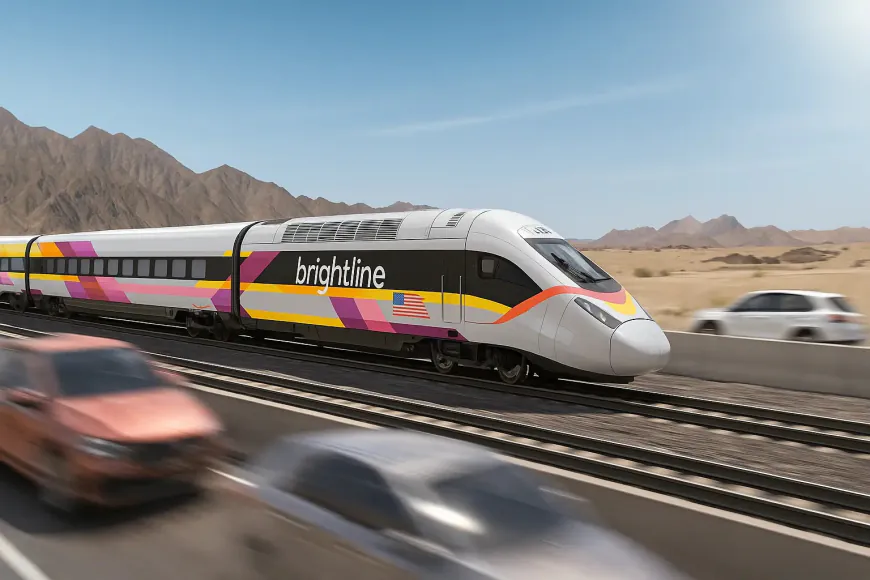
Christoph Seffrin, Head of High Speed US at Siemens Mobility, presented the American Pioneer 220, designed as the first true high-speed rail solution developed specifically for the United States.
These zero-emission trains are designed to travel at 220 mph and connect Los Angeles and Las Vegas on the Brightline West network. This exceptional speed positions the project among the world's most ambitious high-speed rail transport projects.
Technological Innovation: Digital Twins
Siemens leverages digital twin technology to implement new technologies. This approach significantly reduces the need to purchase and test numerous solutions at early stages, facilitating the introduction of modern high-speed trains to the US within reasonable budget constraints.
Siemens' ambition goes beyond simply delivering trains. The German company aims to "transform the entire passenger rail ecosystem in the United States," offering modular and flexible trains that exceed ADA requirements and adapt to technological evolution.
Economic Impact: $166 Billion in Congestion Costs
Seffrin highlighted the considerable societal cost of traffic congestion: 8.8 billion hours lost annually in the US, costing the economy $166 billion. These dramatic figures demonstrate the urgency of a high-speed rail solution as a viable alternative to road transport.
Stadler: Seamless Integration and Modular Technologies
Martin Ritter, President & CEO of Stadler US, emphasized the importance of seamless integration of high-speed services into broader, efficient transport networks. This holistic approach distinguishes Stadler from its competitors.
Although European, Stadler operates a US production facility in Salt Lake City, Utah, demonstrating its commitment to the American market. This local presence allows better understanding of American regulatory and operational specificities.
Proven Technologies: FLIRT and KISS
In the US, Stadler is known for its single-level FLIRT trains (available with electric, diesel, hydrogen, or battery propulsion) and double-decker KISS trains used on Caltrain's electrified route. The company has also been selected to supply 127 two-car metro trains in Atlanta.
This technological diversity allows Stadler to adapt its proven European technologies to American rail networks, offering different propulsion systems to meet the needs of a broader network connected to high-speed rail.
Structural Challenges and Critical Requirements
Sustained Political Will and Funding
The main challenge identified by all manufacturers concerns sustained political will and long-term funding. Without continuity in support, the emerging supply chains that manufacturers have developed will dissolve before they can truly scale.
This situation creates a paradox: manufacturers possess the necessary expertise and technology, but the political and economic environment remains too volatile to guarantee long-term success of these massive investments.
Proven Technologies versus Constant Innovation
Speakers advocated for a pragmatic approach: prioritizing integration and scaling of proven technologies rather than constantly aspiring to new innovations. Scott Sherin of Alstom explicitly questioned why the focus is on innovation when the real need is to "get proven technology on the tracks."
This philosophy opposes the constant attraction to revolutionary technologies like Hyperloop. Sherin emphasized that rail, unlike the automotive industry, "never has the volume to wring out the kinks in new technology."
Maintenance and Infrastructure: The American Reality Challenge
A specific challenge in the US concerns infrastructure maintenance underfunding, leading to inconsistent maintenance regimes. This reality must be integrated into the design and delivery of new high-speed trains.
This issue distinguishes the American market from European or Asian markets, where rail infrastructure generally benefits from more regular and standardized maintenance. Manufacturers must therefore adapt their technologies to compensate for these infrastructure deficiencies.
Public-Private Ecosystem: Key to Success
APTA seminar discussions highlighted that high-speed rail cannot be delivered by manufacturers alone. It requires a robust ecosystem of public-private coordination, regulatory clarity, and commitment to scaling what works.
This systemic approach implies a profound transformation in how the United States approaches rail infrastructure projects. It requires a long-term vision that recognizes rail as critical national infrastructure, on par with highways or airports.
Conclusion: Real but Fragile Momentum
Analysis of American manufacturing capabilities for high-speed rail reveals a nuanced reality. The momentum behind high-speed rail in the United States is real but remains fragile. Manufacturers like Alstom, Siemens, and Stadler have demonstrated their ability to deliver the vehicles necessary for these transformative projects.
However, their success depends on three fundamental pillars: consistent funding, stable policy, and a long-term vision that recognizes rail as critical national infrastructure.
The fundamental question remains: will the broader political and economic environment sufficiently support this sustained industrial growth? The answer to this question will determine whether the United States succeeds in its transition to the high-speed rail era or whether this historic opportunity will once again be missed.
Whats your reaction
 Like
0
Like
0
 Dislike
0
Dislike
0
 Love
0
Love
0
 Funny
0
Funny
0
 Wow
0
Wow
0
 Sad
0
Sad
0
 Angry
0
Angry
0

TrainsNews

Comments (0)