

Toronto to Montreal by train: VIA Rail times, fares and tips (2026)
Toronto to Montréal by VIA Rail in about 5 to 5½ hours, six trains a day, from about CA$55. Timetable, fares, luggage, airport links, punctuality and the Alto high-speed project.
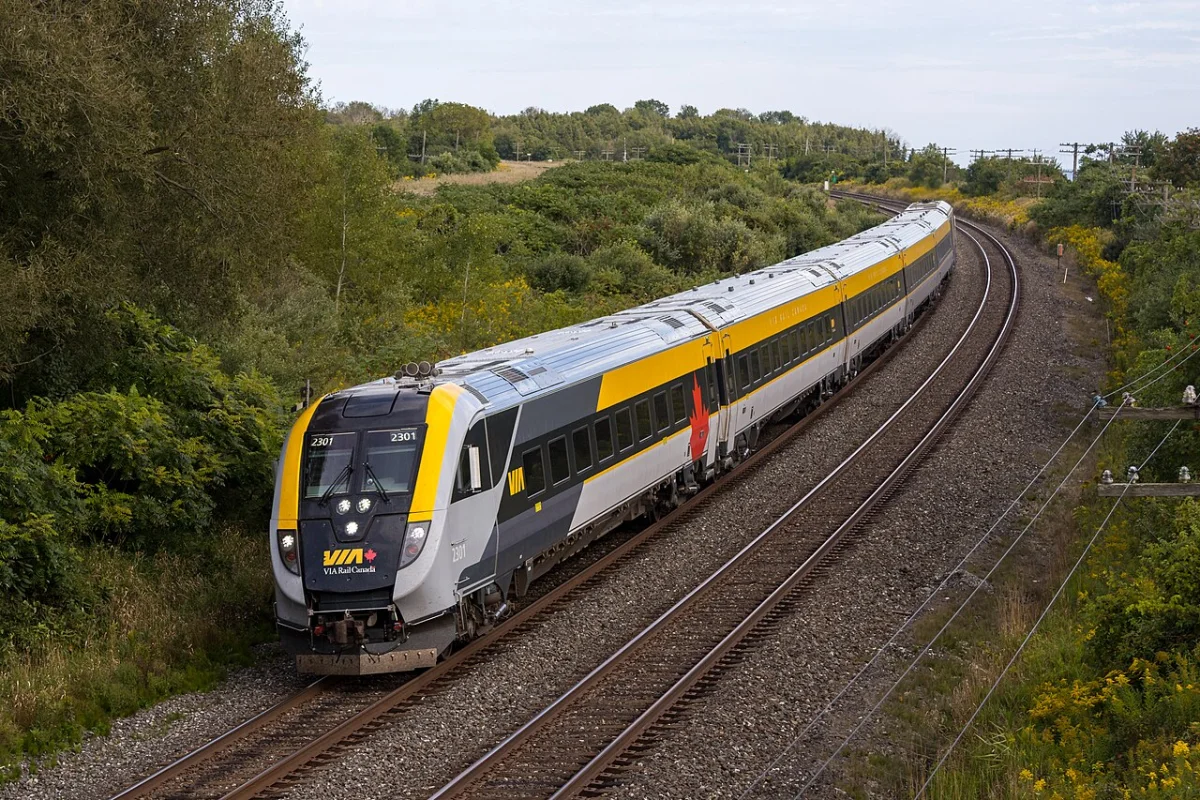
By the TrainsNews rail expert · updated 16 October 2026
VIA Rail runs about six trains a day in each direction between Toronto Union and Montréal Central, taking about 5 to 5½ hours for the 538 km trip. Economy fares start at around CA$55 one way, Wi-Fi is free throughout, and the Corridor fleet is now almost entirely made up of new Siemens Venture trains. The catch is punctuality: VIA's trains run on freight railway CN's tracks and arrived on time only 35% of the time in 2025. Here is everything you need to know, including when the Alto high-speed line could cut the trip to about 3 hours.
Toronto to Montréal at a glance
| Item | Details |
|---|---|
| Operator | VIA Rail Canada |
| Journey time | About 5 h to 5 h 32; VIA's average is 5 h 21 |
| Trains per day | About 6 each way on weekdays, fewer on some weekend days |
| First and last trains | From Toronto 06:32 and about 18:08; from Montréal 06:45 and about 18:09 |
| Main stops | Guildwood, Kingston, Dorval (for Montréal-Trudeau airport) and other lakeshore towns, depending on the train |
| Trains | Siemens Venture (Charger locomotive + 5 cars), up to 160 km/h |
| Fares (one way, indicative) | Economy from about CA$55; Business from about CA$137 |
Timetable
From Toronto, the 2026 timetable has departures at about 06:32, 08:32, 11:38, 15:23, 17:08 and 18:08; the late-afternoon trains are among the fastest, at about 5 hours. From Montréal, trains leave at about 06:45, 08:46, 10:49, 13:22, 16:38 and 18:09. Some trains run on weekdays only, and from 25 October 2026 trains 668 and 669 replace trains 68 and 69 on Saturdays. Always check the exact time on viarail.ca.
There is no non-stop express: VIA announced a non-stop pilot for 29 September 2025, but postponed it on launch day because of "operational constraints" with CN; no relaunch had been announced by October 2026.
Fares and classes
| Fare | Main conditions |
|---|---|
| Escape (online only) | Cheapest; no changes or refunds; seat selection CA$7; 1 medium carry-on |
| Economy | Changes and refunds for 25% of the fare (minimum CA$20) |
| Economy Plus | Free changes, full refund; lounge access available for CA$20 |
| Business | Meal and drinks included, priority boarding, lounge; 1 large carry-on plus a second bag free |
| Business Plus | Fully flexible and refundable, seat selection included |
Prices change with demand and exclude sales tax. As a guide, Economy starts around CA$55 and Business around CA$137 one way when booked early; walk-up fares are much higher. Bookings open about 11 months ahead. Savings: Discount Tuesdays (book on a Tuesday with the code TUESDAY), CAA members (up to 20% off) and limited advance-purchase fares. The summer Canada Strong Pass (in 2025, under-18s travelled free with an adult) ended on 7 September 2026.
Stations and airport links
- Toronto Union: VIA's hall faces the Royal York Hotel. The UP Express reaches Pearson Airport in about 25 minutes, every 15 minutes, for CA$12.35 (CA$9.25 with PRESTO).
- Montréal Central (Gare Centrale): downtown, with a VIA Business lounge. The STM 747 bus runs to Montréal-Trudeau airport every 10 to 20 minutes for CA$11.25 (a 24-hour pass; coins only if paying cash).
- Dorval: get off here for the airport and take VIA's free shuttle to Montréal-Trudeau (YUL). The REM light-metro airport station is not expected before 2027.
Luggage and life on board
- No checked baggage: Corridor trains have run without baggage cars since 2020. You carry your bags on board.
- Carry-ons: Economy fares include one medium bag (25 × 16 × 12 in, up to 23 kg); extra bags cost CA$15 to 25 depending on the fare, or CA$50 if added at boarding. Business includes a large bag and a second one free.
- Bikes: full-size bikes are not carried on Toronto–Montréal trains; folding bikes are accepted as carry-on.
- Services: free Wi-Fi and power outlets in both classes. Economy has a snack and drinks service (cards only). Business includes a meal, bar service and lounge access.
Punctuality: what to expect
Most of the route between Toronto and Montréal belongs to CN, whose freight trains have priority. VIA's on-time performance fell from 51% in 2024 to 35% in 2025, and it was 33% company-wide in the first quarter of 2026. Part of the problem is specific to the new trains: since October 2024, CN has imposed speed restrictions at level crossings because the light Venture sets may not reliably trigger crossing warning circuits. Transport Canada also linked a series of major breakdowns in December 2025 and January 2026 to the new fleet. If you have a flight or a meeting, allow at least an hour of margin.
The future: Alto high-speed rail
Alto, a federal Crown corporation, is developing a 1,000 km high-speed line between Toronto and Québec City on dedicated, electrified track at up to 300 km/h, with stations planned in Toronto, Peterborough, Ottawa, Laval, Montréal, Trois-Rivières and Québec City. Toronto–Montréal would take about 3 hours, against 5 h 20 today. The private partner, the Cadence consortium, includes CDPQ Infra, AtkinsRéalis, Keolis, SYSTRA, Air Canada and SNCF Voyageurs.
Construction is due to start on the first section, Ottawa–Montréal, in 2029, with the Toronto sections from about 2032. In October 2026 the exact route was still not fixed. Alto estimates the cost at C$60 to 90 billion; the Parliamentary Budget Officer put it at C$75 to 113 billion on 1 October 2026. Unofficial estimates put the first section in service in the late 2030s and the full line, including Toronto, in the 2040s.
An expert's view
The Venture trains are not the bottleneck: they are designed for 201 km/h, but Canadian track rules limit passenger trains to 160 km/h on this corridor, and shared freight track caps capacity and reliability. Level-crossing detection is a classic issue with lightweight modern trainsets: track circuits rely on the train's wheels and axles to short the rails, and fewer, lighter axles can make detection less reliable. Fixes exist (shunt enhancers, axle counters, updated warning-time tables), but they must be deployed crossing by crossing with the track owner.
That is why Alto matters. A dedicated line removes the freight conflict, the level crossings and the speed cap at once. Until then, VIA's best lever is negotiating passing sidings and dispatching priority with CN.
Frequently asked questions
How long is the train from Toronto to Montréal?
About 5 to 5½ hours, depending on the train; VIA's average is 5 h 21.
How many trains a day are there?
About six in each direction on weekdays, with fewer trains on some weekend days.
How much is the train?
From about CA$55 one way in Economy and CA$137 in Business when booked early; fares rise as the train fills.
Can I check a suitcase?
No. There is no checked baggage on Corridor trains; Economy includes one medium carry-on.
How do I get to Montréal-Trudeau airport by train?
Get off at Dorval and take VIA's free shuttle, or take the 747 bus from downtown Montréal.
When will high-speed rail cut the trip to 3 hours?
Not before the 2040s according to unofficial estimates: Alto starts construction on Ottawa–Montréal in 2029, and the Toronto sections from about 2032.
Key takeaways
- About six trains a day, about 5 to 5½ hours, from about CA$55.
- No checked bags; free Wi-Fi in both classes.
- Allow a margin: on-time performance was 35% in 2025.
Read also
- Acela: Boston–New York–Washington
- Brightline: Miami to Orlando by train
- London to Paris by Eurostar
- All our train travel guides
For rail enthusiasts
T-shirts, mugs and posters for train lovers: visit the TrainsNews Store.
Sources: VIA Rail, Montréal–Toronto (viewed 16 October 2026); VIA Rail, fare comparison; VIA Rail, classes and services; VIA Rail, Montréal-Trudeau shuttle; CP24, non-stop pilot postponed (29 September 2025); CP24, autumn 2026 schedule changes (16 September 2026); Transport Canada, operating restrictions in the Corridor (February 2026); Transport Canada, VIA Rail train delays (February 2026); Railway Age, VIA Rail 2025 results (7 May 2026); Toronto Pearson, UP Express; STM, 747 airport bus; Transport Canada, Ottawa–Montréal chosen for Alto (12 December 2025); CTV News, Alto route still undecided (7 October 2026); Narcity, PBO cost estimate (October 2026); Seat61, Canada (indicative fares). Information checked on 16 October 2026.
Photo: Dillan Payne, CC BY-SA 4.0, via Wikimedia Commons
Written with AI assistance from the official sources cited, reviewed by the TrainsNews editorial team. Real photo, credited below the image. Spotted an error? contact@trainsnews.com — Our AI policy
Whats your reaction
 Like
0
Like
0
 Dislike
0
Dislike
0
 Love
0
Love
0
 Funny
0
Funny
0
 Wow
0
Wow
0
 Sad
0
Sad
0
 Angry
0
Angry
0

TrainsNews est un média indépendant et bilingue d'actualité ferroviaire mondiale, publié depuis 2024. La rédaction couvre la grande vitesse, le matériel roulant, l'infrastructure, la signalisation et les télécoms ferroviaires (ERTMS/ETCS, CBTC, FRMCS, GSM-R), l'exploitation, le fret et le financement des projets. Chaque article cite ses sources et donne les chiffres avec leur total. TrainsNews is an independent, bilingual (French/English) news outlet covering the global rail industry since 2024: high-speed rail, rolling stock, infrastructure, signalling and telecoms, operations, freight and project financing. Every article cites its sources.








Comments (0)