

FRMCS enters lab testing as FP2-MORANE-2 publishes first test cases
FP2-MORANE-2 has published its first FRMCS system test cases, with lab tests at Ericsson, Nokia and Kontron and field trials from 2027.
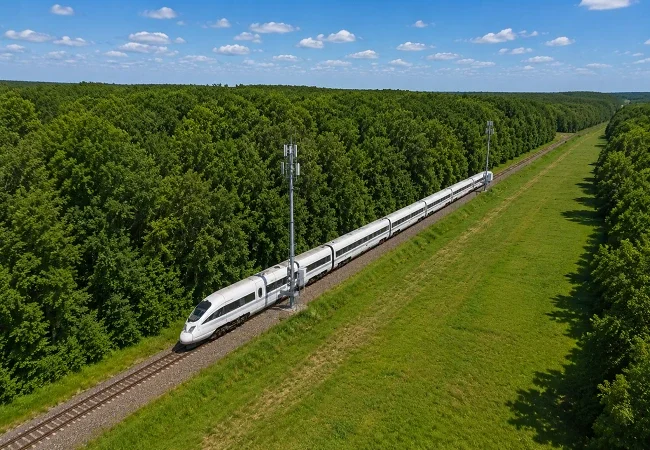
The FP2-MORANE-2 consortium has published its first unified system test cases for the Future Railway Mobile Communication System (FRMCS), the 5G-based successor to GSM-R. At its mid-term conference, held on 30 June 2026 at the Paris headquarters of the International Union of Railways (UIC), the project confirmed that laboratory testing is under way in three integration facilities hosted by Ericsson, Nokia and Kontron, with field trials by Adif, DB InfraGO, ProRail and Trafikverket due to start in 2027.
A €13.5m programme to validate the specifications
FP2-MORANE-2 is a Horizon Europe project coordinated by UIC and co-funded by the Europe's Rail Joint Undertaking and the Smart Networks and Services Joint Undertaking (SNS JU). It started on 1 December 2024 and runs for 34 months, until autumn 2027, with a budget of €13.5m.
The consortium brings together UNIFE, 11 railways and infrastructure managers, 13 suppliers including Alstom, Siemens, Hitachi Rail GTS, Frequentis and Funkwerk, and two mobile network operators, KPN and Telia.
- Start: 1 December 2024, duration 34 months
- Budget: €13.5m (Horizon Europe)
- Labs: 3 (Ericsson, Nokia, Kontron)
- Field trials: five lines in Spain, Germany, the Netherlands and Sweden, from 2027
- Specification baseline: FRMCS v2.2
What the labs are testing
The published test cases are based on FRMCS v2.2 and cover on-board systems, trackside systems and the interfaces between them. Without a common baseline, equipment from different suppliers could pass individual checks yet fail to interoperate on a live network.
The labs are exercising cab radios, dispatcher systems, 5G radio and core networks, mission-critical applications and GSM-R interworking functions. Voice communication, the Railway Emergency Call, ETCS, ATO and on-board TCMS are also being evaluated.
FRMCS reuses the 3GPP mission-critical services framework (MCX: MCPTT for voice, MCData and MCVideo), extended for rail through successive releases from Release 15 onwards to cover functional addressing, multi-talker control and GSM-R interworking. Applications reach the transport layer through standardised gateways: OBapp on board and TSapp trackside. The European Union Agency for Railways (ERA) treats the OBapp interfaces for train protection and train operation communication as mandatory features, which makes ETCS over FRMCS a core validation item rather than an optional extra.
Spectrum and radio layer
FRMCS operates in the harmonised Railway Mobile Radio bands: the paired 874.4–880.0 MHz / 919.4–925.0 MHz block, which overlaps today's GSM-R allocation, and the unpaired 1900–1910 MHz TDD band. 3GPP added the corresponding NR bands, n100 and n101, in Release 17. The 900 MHz band provides coverage along the line, while 1900 MHz adds capacity, which matters during migration when GSM-R still occupies much of the 900 MHz spectrum.
From MORANE to MORANE-2
The project's name refers to MORANE (Mobile Radio for Railway Networks in Europe), the 1990s programme that, alongside the EIRENE specifications, validated GSM-R before deployment began in Europe in 2000. GSM-R is based on 2G technology and suppliers have indicated that support will be available until at least 2030, with ageing hardware and scarce expertise pushing costs up beyond that point. The previous Horizon 2020 project, 5GRAIL, began testing early FRMCS prototypes in November 2020.
The migration itself is the hardest part. Because GSM-R carries ETCS Level 2 data and safety-critical voice, coverage must be continuous during the transition and a Railway Emergency Call raised on one system must reach trains on the other. Fleets will need dual-mode or upgraded cab radios, and existing ETCS on-board units may have to be modified in parallel. ERA notes that the CCS TSI 2023 (Regulation 2023/1695) contains only a first, incomplete version of the FRMCS specifications (V1).
Timeline to the TSI and first deployments
MORANE-2 results feed directly into the specification process. According to the Europe's Rail FRMCS planning report of October 2025, the v2.2 functional and system specifications were scheduled for late 2025 and February 2026, a pre-test V3 version for November 2026 and the post-test V3.0 for September 2027, at the end of the MORANE-2 testing. The report places adoption of the CCS TSI amendment between June 2028 (best case) and June 2029 (worst case), later than the 2027 TSI revision announced when the project was launched.
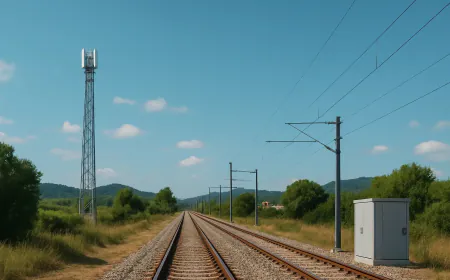
Field trials will cover one conventional and one high-speed line in Spain and conventional lines in Germany, Sweden and the Netherlands, including cross-border scenarios. Infrastructure managers are already building masts, fitting on-board equipment and deploying mission-critical 5G cores. Key points to watch are the stability of V3 and the authorisation of dual-mode vehicles.
Update (October 2026)
In July 2026, Ericsson and DB InfraGO carried out what Ericsson describes as the first end-to-end FRMCS validation on real trains in the 1900 MHz railway band, with the results feeding into MORANE-2. At InnoTrans in Berlin (22–25 September 2026), Eviden and AllWayTon launched a triple-mode GSM-R/FRMCS/public 5G handheld intended for gradual migration.
Sources: Railway Gazette International, 2 July 2026; Railway Pro, 8 July 2026; FP2-MORANE-2 project website; International Railway Journal; Global Railway Review; Europe's Rail, FRMCS V2 report, October 2025; ERA, Opinion ERA/OPI/2024-10; 3GPP; Rail Engineer; Ericsson, 18 September 2026; Eviden/AllWayTon, 22 September 2026.
Whats your reaction
 Like
0
Like
0
 Dislike
0
Dislike
0
 Love
0
Love
0
 Funny
0
Funny
0
 Wow
0
Wow
0
 Sad
0
Sad
0
 Angry
0
Angry
0

TrainsNews est un média indépendant et bilingue d'actualité ferroviaire mondiale, publié depuis 2024. La rédaction couvre la grande vitesse, le matériel roulant, l'infrastructure, la signalisation et les télécoms ferroviaires (ERTMS/ETCS, CBTC, FRMCS, GSM-R), l'exploitation, le fret et le financement des projets. Chaque article cite ses sources et donne les chiffres avec leur total. TrainsNews is an independent, bilingual (French/English) news outlet covering the global rail industry since 2024: high-speed rail, rolling stock, infrastructure, signalling and telecoms, operations, freight and project financing. Every article cites its sources.
Comments (0)