

Mongolia opens 127 km freight bypass around Ulaanbaatar
Mongolia opened a 127.1 km freight bypass around Ulaanbaatar on 11 October 2026, expected to carry 20 Mt in year one and remove about 1,800 heavy trucks a day from the capital.
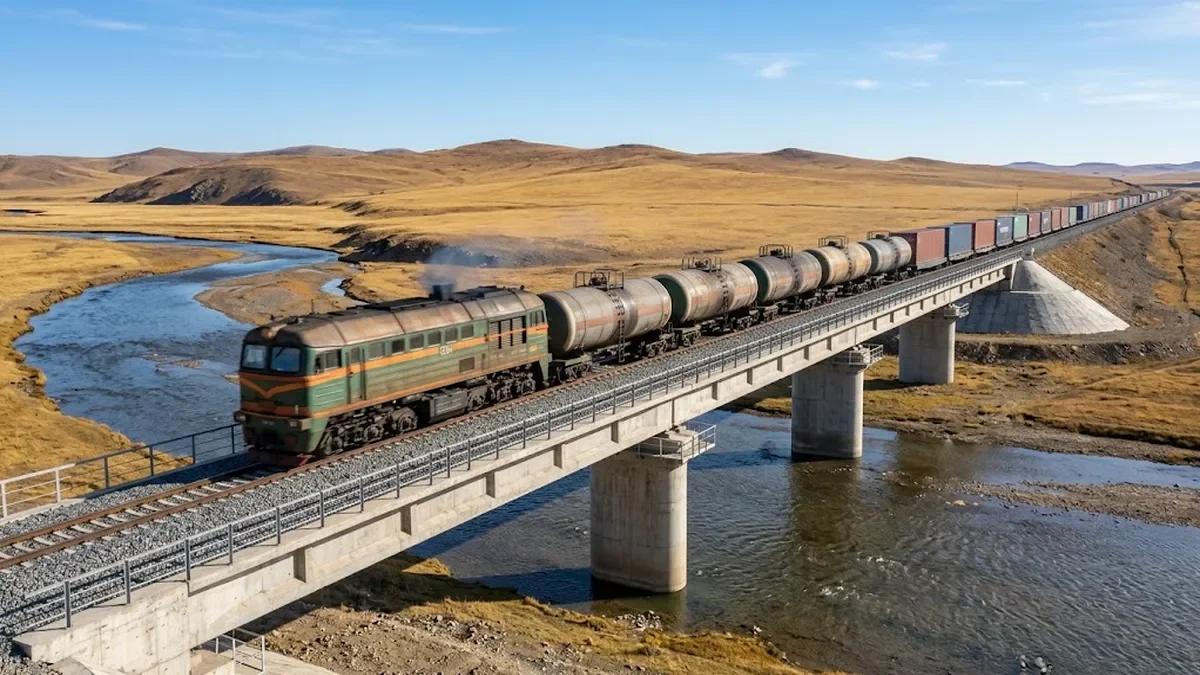
Mongolia has opened a 127.1 km railway that takes freight trains around its capital, Ulaanbaatar, instead of through the city centre. President Khurelsukh Ukhnaa attended the commissioning ceremony on 11 October 2026, according to the state news agency MONTSAME. The line runs from Bagakhangai to Emeelt via the Khushig Valley. It is expected to carry 20 million tonnes of freight in its first year, rising to 25 million tonnes a year, and to take about 1,800 heavy trucks a day off the capital's streets.
A new line built in just over a year
The bypass leaves the existing main line at Bagakhangai station, southeast of the capital, crosses Sergelen and Altanbulag districts in Töv province and rejoins the main line at Emeelt station. It passes through the Khushig Valley, home to Chinggis Khaan International Airport. Key figures from MONTSAME:
- route length 127.1 km, with 177 km of track in total including station tracks and sidings;
- a Class III railway with four stations and three passing loops (places where trains can pass each other);
- eight bridges with a combined length of 1,279 m, plus 127 reinforced concrete culverts and underpasses;
- a 476 m bridge over the Tuul River, on 20 piers and 38 girders, described as the longest bridge in Mongolia;
- a highest bridge 22 m tall and 176 m long.
The project was led by the state-owned Mongolian Railway (MTZ). Works began in April 2025. More than 160 Mongolian companies and about 4,000 workers took part. In August 2026, MTZ put the total investment at MNT 1.9 trillion, including USD 100 million of financing from the Development Bank of Mongolia.
Taking freight and dangerous goods out of the city
From now on, 34 categories of hazardous and explosive cargo may no longer travel through central Ulaanbaatar. Level crossing closures currently hold up road traffic in the city for an average of 144 minutes a day. With fewer trains crossing the city, that figure is expected to fall to around 120 minutes.
Further work is planned along the new line:
- a multi-purpose freight terminal at km 87.8;
- a dedicated hazardous cargo terminal at km 102;
- the gradual relocation of 13 freight terminals that now operate inside the capital, freeing land for public use.
At the ceremony, the President said the bypass "will play a critical role in Ulaanbaatar's expansion". He asked the authorities to focus on reliable operations, transport capacity, flexible tariffs, lower logistics costs and staff training.
TrainsNews analysis
Ulaanbaatar sits on Mongolia's north-south main line between Russia and China, a 1,520 mm gauge railway. Until now, every through freight train crossed the city centre and its level crossings. Moving freight out of the city is a sound decision for safety and urban planning.
The open question is capacity. A total of 177 km of track for a 127 km route, with three passing loops, points to a mainly single-track line. On single track, capacity depends on the distance between passing points and on the signalling. The type of signalling and train control has not been disclosed. Reaching 20 to 25 million tonnes a year will require long, heavy trains, short dwell times at loops and reliable block signalling between stations.
Speed of construction is the second risk. A new line built in about a year, in a climate with very cold winters and deep frost, often needs extra maintenance on fresh embankments during its first seasons. Temporary speed restrictions would not be a surprise. Finally, the full benefit depends on the new terminals. As long as freight is still loaded and unloaded in the city, some trains and trucks will continue to enter Ulaanbaatar.
Further reading: our directory of Asia-Pacific rail infrastructure managers and our train travel guides.
Sources: MONTSAME, Mongolian state news agency (12 October 2026); Mongolian Railway (MTZ) news release (24 August 2026); International Railway Journal (14 October 2026).
Whats your reaction
 Like
0
Like
0
 Dislike
0
Dislike
0
 Love
0
Love
0
 Funny
0
Funny
0
 Wow
0
Wow
0
 Sad
0
Sad
0
 Angry
0
Angry
0

TrainsNews est un média indépendant et bilingue d'actualité ferroviaire mondiale, publié depuis 2024. La rédaction couvre la grande vitesse, le matériel roulant, l'infrastructure, la signalisation et les télécoms ferroviaires (ERTMS/ETCS, CBTC, FRMCS, GSM-R), l'exploitation, le fret et le financement des projets. Chaque article cite ses sources et donne les chiffres avec leur total. TrainsNews is an independent, bilingual (French/English) news outlet covering the global rail industry since 2024: high-speed rail, rolling stock, infrastructure, signalling and telecoms, operations, freight and project financing. Every article cites its sources.









Comments (0)