

Kumamoto earthquake: all rail lines back in service after 77 days
The last line closed by the July 2026 Kumamoto earthquake has reopened. The Kyushu Shinkansen had about 1,000 damage points and still runs at 70 km/h near Shin-Yatsushiro.
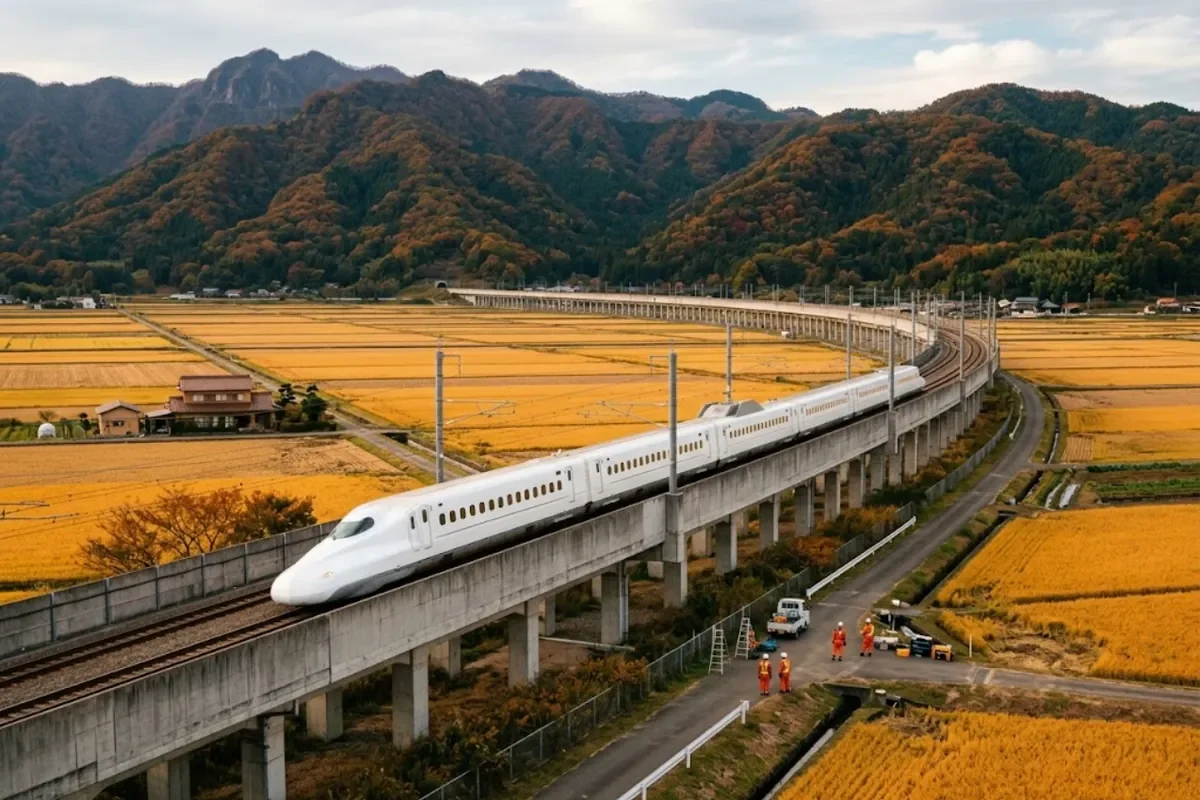
All railway lines suspended after the 28 July 2026 earthquake in Kumamoto Prefecture, Japan, are back in service. The last section, on the Hisatsu Orange Railway between Yatsushiro and Higo-Tauura, reopened on 13 October, 77 days after the quake, which reached the maximum level of 7 on the Japanese seismic intensity scale.
Three lines, three timetables
According to the Kumamoto Nichinichi Shimbun and Jiji Press, service was restored in stages:
- Kyushu Shinkansen (JR Kyushu): the Kumamoto–Shin-Minamata section reopened on 18 September, 52 days after the quake, restoring the full Hakata–Kagoshima-Chuo line;
- Kagoshima Main Line (JR Kyushu, Uto–Yatsushiro): reopened on 10 October;
- Hisatsu Orange Railway: Higo-Tauura–Minamata reopened on 1 September, and Yatsushiro–Higo-Tauura on 13 October.
About 1,000 damage points on the Shinkansen
The damage was far heavier than in the 2016 Kumamoto earthquake, according to a damage review compiled from operator figures. On the Shinkansen between Kumamoto and Shin-Yatsushiro, about 1,000 points were affected: around 600 on structures, 300 on track and 100 on electrical wiring. Rails broke near Shin-Yatsushiro and bridge girders shifted. On the Kagoshima Main Line, 29 bridges were deformed, about 10 km of track was distorted and 27 overhead line poles were damaged. The Kagoshima line runs close to the Hinagu fault.
JR Kyushu still limits Shinkansen trains to 70 km/h over about 10 km near Shin-Yatsushiro, which adds about eight minutes between Kumamoto and Kagoshima-Chuo, and has cut services between Kagoshima-Chuo and the Sanyo Shinkansen by about 10%.
TrainsNews analysis
Japan restored a high-speed line hit by an intensity-7 earthquake in under two months, but the recovery is not over: the speed restriction shows that track geometry and structures near the fault still need work. For the third-sector Hisatsu Orange Railway, a small operator owned largely by local governments, the repair bill is a real burden, and disaster subsidies will matter. For European infrastructure managers facing more extreme weather, the Kyushu case is a useful reminder that resilience is measured as much by recovery time as by how much damage is avoided.
Related: rail maintenance and safety news, our directory of Asia-Pacific rail infrastructure managers and more rail news from Asia.
Sources: Kumamoto Nichinichi Shimbun (13 October 2026); Jiji Press via Nippon.com (18 September 2026); damage review by Tetsudo Kyogikai.
Whats your reaction
 Like
0
Like
0
 Dislike
0
Dislike
0
 Love
0
Love
0
 Funny
0
Funny
0
 Wow
0
Wow
0
 Sad
0
Sad
0
 Angry
0
Angry
0

TrainsNews est un média indépendant et bilingue d'actualité ferroviaire mondiale, publié depuis 2024. La rédaction couvre la grande vitesse, le matériel roulant, l'infrastructure, la signalisation et les télécoms ferroviaires (ERTMS/ETCS, CBTC, FRMCS, GSM-R), l'exploitation, le fret et le financement des projets. Chaque article cite ses sources et donne les chiffres avec leur total. TrainsNews is an independent, bilingual (French/English) news outlet covering the global rail industry since 2024: high-speed rail, rolling stock, infrastructure, signalling and telecoms, operations, freight and project financing. Every article cites its sources.












Comments (0)