

Alto high-speed rail could cost up to C$113bn, budget watchdog warns
Canada's Parliamentary Budget Officer puts the Toronto–Quebec City Alto line at C$75bn to C$113bn, above Ottawa's C$60bn to C$90bn range.
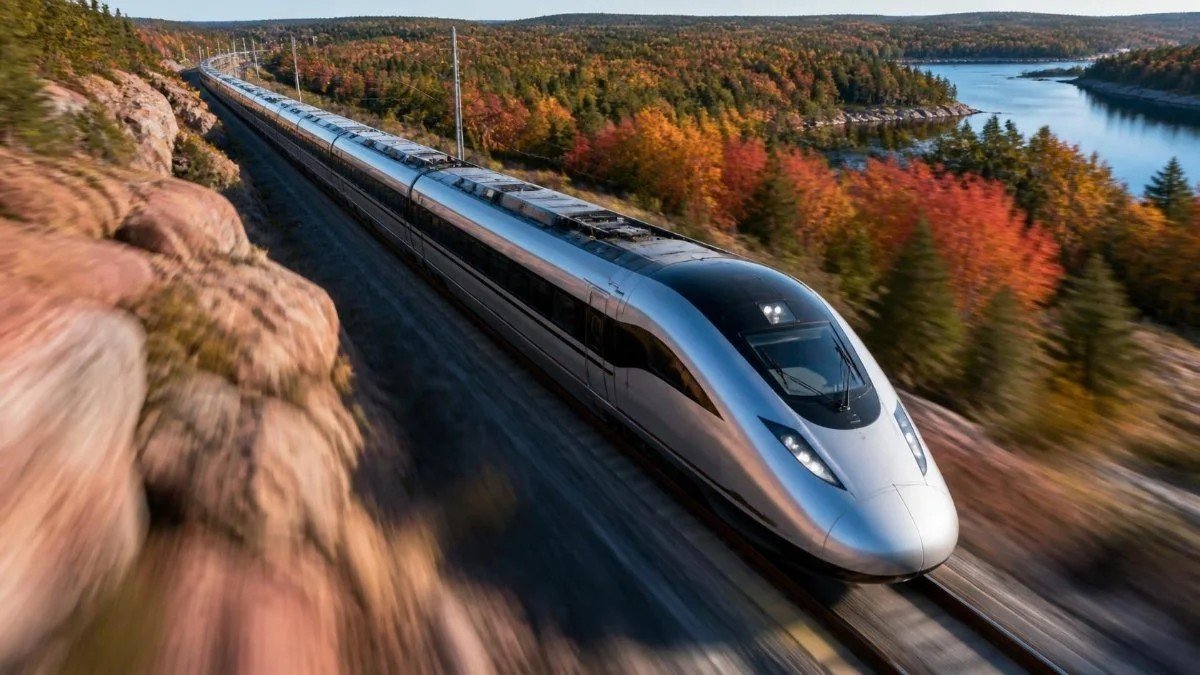
Canada's Toronto–Quebec City high-speed rail line, Alto, could cost between C$75bn and C$113bn to build, according to a report published on 1 October 2026 by the Parliamentary Budget Officer (PBO), in a study titled Canada's Eastern Corridor High-Speed Rail: A Cost Analysis using Global Data. That is well above the federal government's own range of C$60bn to C$90bn. The watchdog points to a 15 km tunnel under Montreal and the Canadian Shield as the main cost risks.
PBO estimate: up to C$23bn above Ottawa's range
The PBO's range sits higher than Ottawa's at both ends:
- Low case: C$75bn, versus C$60bn in the government estimate, a gap of C$15bn.
- High case: C$113bn, versus C$90bn, a gap of C$23bn.
To build its figures, the budget officer reviewed 94 high-speed rail projects worldwide. The analysis found that projects in the United Kingdom and the United States tend to overrun their budgets more than European projects, a warning for a country with no high-speed track record of its own. The California high-speed rail programme and the delayed NextGen Acela are two North American reminders of how quickly schedules and budgets can slip.
Montreal tunnel and Canadian Shield: the two big risks
The report singles out two engineering challenges along the roughly 1,000 km route:
- The Montreal tunnel: about 15 km, estimated at C$169m per kilometre, or around C$2.5bn. That is only 2 to 3% of the total project cost, but the PBO flags it as a significant risk for both cost overruns and construction delays.
- The Canadian Shield: the hard, uneven Precambrian rock between Ottawa and Peterborough makes earthworks, cuttings and structures far more expensive than on flat ground.
Time is also money. Construction is not expected to start before 2030, and the PBO estimates that every year of delay adds about C$1.5bn to the bill.
What Alto is planned to deliver
Alto is designed as a dedicated, electrified high-speed line running at 300 km/h or more. It is being developed with the Cadence consortium, whose partners include France's SNCF Voyageurs, Keolis and Air Canada.
The planned stations are Toronto, Peterborough, Ottawa, Montreal, Laval, Trois-Rivières and Quebec City, with Kingston recently added. Alto's projected journey times are:
- Toronto–Montreal: 3 h 07
- Ottawa–Montreal: 58 min
- Montreal–Quebec City: 1 h 29
The first section to open is expected to be Ottawa–Montreal, in the second half of the 2030s. Full completion of the corridor is projected for the early 2040s.
Political pressure is rising
The new estimate has hardened opposition. The Conservative Party, which once backed the project, now calls it unaffordable, with transport critic Dan Albas saying "Canadians are out of money." Rural communities along the route fear years of construction disruption, and Quebec's farmers' union has called for the project to be suspended.
For the federal government, the challenge is to keep the cost range under control before the design phase locks in the alignment, especially the Montreal tunnel and the route across the Shield.
Key takeaways
- The PBO puts Alto at C$75bn to C$113bn, against the government's C$60bn to C$90bn.
- The 15 km Montreal tunnel, at around C$2.5bn, is small in the total but high-risk.
- The Canadian Shield between Ottawa and Peterborough is the other major cost driver.
- Each year of delay adds about C$1.5bn, and construction should not start before 2030.
- Toronto–Montreal is planned in 3 h 07, at speeds of 300 km/h or more.
Follow all our coverage of the region in our North America section and of new trainsets in High-speed train.
Sources: Parliamentary Budget Officer (PBO), CTV News, CP24, Alto.
AI-generated illustration.
Whats your reaction
 Like
0
Like
0
 Dislike
0
Dislike
0
 Love
0
Love
0
 Funny
0
Funny
0
 Wow
0
Wow
0
 Sad
0
Sad
0
 Angry
0
Angry
0

TrainsNews est un média indépendant et bilingue d'actualité ferroviaire mondiale, publié depuis 2024. La rédaction couvre la grande vitesse, le matériel roulant, l'infrastructure, la signalisation et les télécoms ferroviaires (ERTMS/ETCS, CBTC, FRMCS, GSM-R), l'exploitation, le fret et le financement des projets. Chaque article cite ses sources et donne les chiffres avec leur total. TrainsNews is an independent, bilingual (French/English) news outlet covering the global rail industry since 2024: high-speed rail, rolling stock, infrastructure, signalling and telecoms, operations, freight and project financing. Every article cites its sources.










Comments (0)