

Seoul to Busan by KTX: fares, times and the 2026 SRT merger
Seoul to Busan in 2 h 08 at best on KTX, from about ₩54,000 in standard class. KTX and SRT merged on 1 September 2026: stations, fares, booking, luggage and an engineer's view.
By the TrainsNews rail expert · updated 15 October 2026
Seoul to Busan is South Korea's main rail route: about 417 km covered by KTX high-speed trains in as little as 2 hours 8 minutes, at up to 305 km/h. Since 1 September 2026, KTX and its former rival SRT run as a single service under the KTX name, with one app to book both and lower fares on the old KTX routes. Here is what you need to know before you ride.
Seoul–Busan at a glance
| Item | Detail |
|---|---|
| Operator | Korail (KTX), which took over SR (SRT) in 2026 |
| Fastest journey | 2 h 08 non-stop; about 2 h 40 on a typical train |
| Distance | About 417 km on the Gyeongbu high-speed line |
| Top speed | 305 km/h |
| Standard fare | About ₩54,000 since 1 September 2026 (down from ₩59,800) |
| Seoul terminals | Seoul Station and Suseo (Gangnam) |
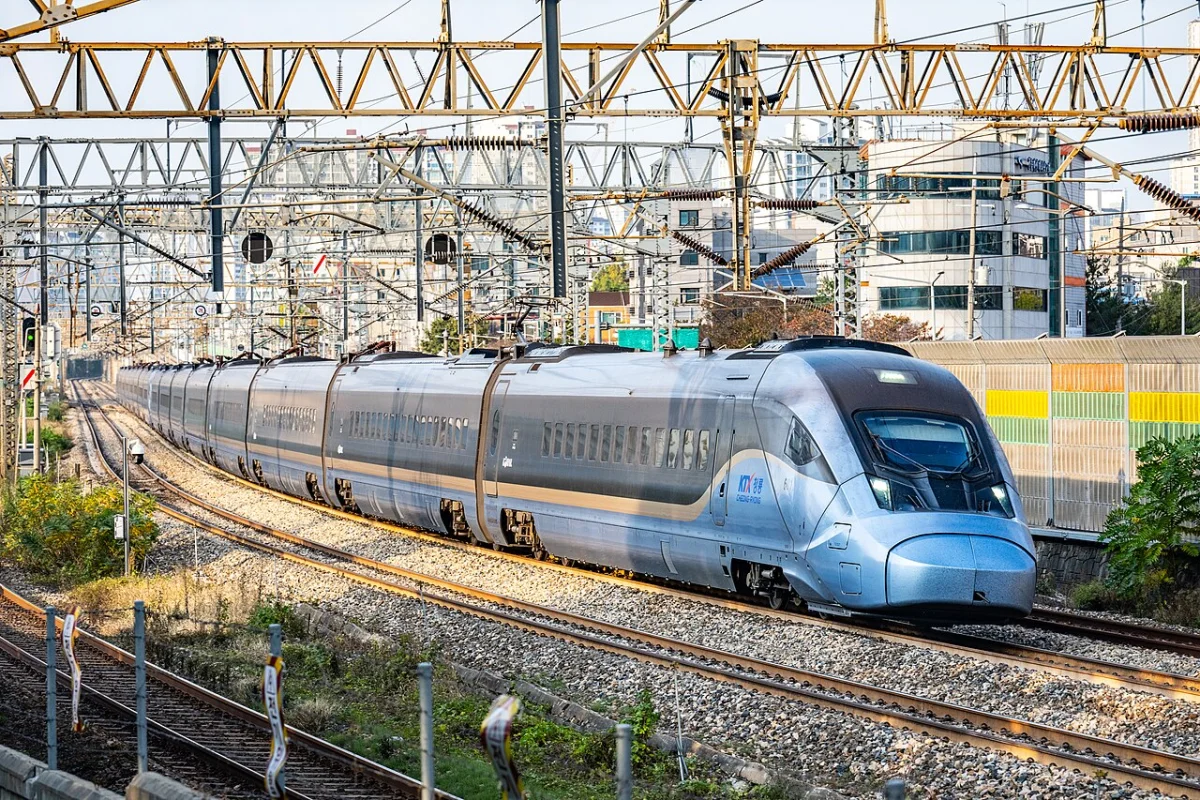
| Trains | KTX, KTX-Sancheon and KTX-Cheongryong |
KTX and SRT: what changed in 2026
Until 2026, Seoul–Busan was served by two operators: KTX from Seoul Station and SRT from Suseo in southern Seoul. The two networks were merged step by step: trial cross-running in February, coupled KTX+SRT trains from May, and full integration on 1 September 2026. For travellers, this means:
- One brand and one app: the Korail+ app (which replaced Korail Talk in August 2026) books every train, including the former SRT services.
- Both Seoul terminals: trains to Busan now leave from both Seoul Station and Suseo.
- More seats: about 15,000 extra seats per day on weekdays and 17,000 at weekends across the network.
- Cheaper tickets: KTX fares were cut by about 10% to former SRT levels, with the cut guaranteed for three years.
Stations
- Seoul Station: the main KTX terminal in central Seoul.
- Suseo: the former SRT terminal in Gangnam, linked to Metro Line 3, the Suin–Bundang line and the GTX-A express line.
- Gwangmyeong: a station on the high-speed line south-west of Seoul.
- Daejeon and Dongdaegu (Daegu): the main intermediate stops.
- Busan: the southern terminus, in the city centre.
Fares
| Ticket | Price | Notes |
|---|---|---|
| Standard class, Seoul–Busan | About ₩54,000 | Since 1 September 2026, about 10% less than before (₩59,800) |
| Online discount fare | 10–30% off | On trains with many empty seats, from September 2026 |
| Korail Pass (foreign visitors) | From about ₩131,000 for 2 days | Travel days used within a 10-day period; passport holders only; reseller price |
Korean media report slightly different figures for the new standard fare, so check the exact price in the Korail+ app. Every ticket now earns 5% mileage. Prices checked on 15 October 2026; the price shown at booking applies.
Is the Korail Pass worth it? Only if you take several long trips: a Seoul–Busan return costs about ₩108,000, less than a 2-day pass.
Booking
- Where: the Korail+ app or Korail's English website. Foreign visitors book with a passport and a bank card; no Korean ID number is needed.
- How far ahead: Korean media report that the booking window was extended from 30 to 60 days from 1 October 2026.
- Weekends and holidays: book early for Chuseok and Lunar New Year (Seollal), when seats sell out and standing tickets are sold.
- Cancellation on Friday to Sunday and holidays: 5% fee one day before departure, 10% on the day (more than 3 hours before), 20% within 3 hours, and up to 70% once the train has left.
Luggage and on board
- Luggage: there is no checked baggage. Keep to bags you can carry yourself, and store them on the racks, not on seats or in the aisle.
- Classes: First and Standard on KTX and KTX-Sancheon; Superior and Standard on KTX-Cheongryong (one Superior car of 46 seats).
- Food: no meal service on board, only vending machines. Buy food at the station before boarding.
- Wi-Fi: available on board.
What's next
- More trains: 31 new eight-car sets of about 500 seats are due from 2027.
- Retiring the first KTX: Korail plans to replace its original TGV-derived trains with 49 Korean-built EMU-320 sets, with deliveries expected from 2032.
- Faster KTX-Cheongryong: designed for 320 km/h, it is held to 300 km/h until track works between Pyeongtaek and Osong are finished, due by 2028.
An engineer's view
The Gyeongbu high-speed line opened in two stages: Seoul–Daegu on 1 April 2004, then Daegu–Busan on 1 November 2010, when the 2 h 08 non-stop timing appeared. The line was designed for 350 km/h; trains have run at 305 km/h since 2008.
The first KTX trains came from a 1994 contract with Alstom that included a technology transfer: they are derived from the French TGV Réseau, and the first 12 sets were built in France. The line also uses French-style TVM 430 cab signalling, the same system as the LGV Nord in France: speed limits are shown in the cab rather than on lineside signals.
Korea is now moving to its own system, KTCS-2, compatible with ETCS levels 1 and 2 and using LTE-R radio. It is planned on the Gyeongbu high-speed line by 2028, alongside the switch to Korean-built trains.
Frequently asked questions
Is it KTX or SRT from Seoul to Busan?
Since 1 September 2026 both run as KTX, and one app (Korail+) books both.
How long is the KTX from Seoul to Busan?
2 hours 8 minutes non-stop at best; about 2 hours 40 minutes on a typical train with stops.
How much is a KTX ticket from Seoul to Busan?
About ₩54,000 in standard class since 1 September 2026. Check the exact fare in the app.
Which Seoul station should I use?
Seoul Station for central and northern Seoul, Suseo for Gangnam and southern Seoul. Both now have trains to Busan.
Can foreigners book online?
Yes, on the Korail English website or app, with a passport and a bank card.
Is there food on the KTX?
No meal service, only vending machines. Bring your own food.
Key takeaways
- Seoul to Busan in 2 h 08 at best, from about ₩54,000 in standard class.
- KTX and SRT merged on 1 September 2026: one app, two Seoul terminals.
- Book early for weekends and holidays, and bring your own food.
Read also
- Whoosh Jakarta–Bandung guide
- Haramain High Speed Railway guide
- Paris to Lyon by train
- All our train travel guides
For rail enthusiasts
T-shirts, mugs and posters for train lovers: visit the TrainsNews Store.
Sources: Korea JoongAng Daily, KTX–SRT integration (31 August 2026); Asia Economy, merger and fares (2 August 2026); Kyunghyang Shinmun, extra seats (2 August 2026); Korea Economic Daily, fare cut (2 August 2026); Korea JoongAng Daily, Suseo and Seoul stations (8 December 2025); Korea JoongAng Daily, cancellation fees (27 April 2025); International Railway Journal, KTX-Cheongryong (3 May 2024); Tech Times, EMU-320 fleet (20 July 2026); Gyeongbu high-speed railway. Information checked on 15 October 2026.
Photo: Takeshi Aida, CC BY-SA 2.0, via Wikimedia Commons
Written with AI assistance from the official sources cited, reviewed by the TrainsNews editorial team. Spotted an error? contact@trainsnews.com — Our AI policy
Whats your reaction
 Like
0
Like
0
 Dislike
0
Dislike
0
 Love
0
Love
0
 Funny
0
Funny
0
 Wow
0
Wow
0
 Sad
0
Sad
0
 Angry
0
Angry
0

TrainsNews est un média indépendant et bilingue d'actualité ferroviaire mondiale, publié depuis 2024. La rédaction couvre la grande vitesse, le matériel roulant, l'infrastructure, la signalisation et les télécoms ferroviaires (ERTMS/ETCS, CBTC, FRMCS, GSM-R), l'exploitation, le fret et le financement des projets. Chaque article cite ses sources et donne les chiffres avec leur total. TrainsNews is an independent, bilingual (French/English) news outlet covering the global rail industry since 2024: high-speed rail, rolling stock, infrastructure, signalling and telecoms, operations, freight and project financing. Every article cites its sources.



Comments (0)