

East Palestine derailment: a failed bearing and an unnecessary burn
In February 2023 an overheated bearing derailed 38 cars of a Norfolk Southern train in East Palestine, Ohio. The NTSB later found the vent and burn of five tank cars unnecessary.
On 3 February 2023, Norfolk Southern freight train 32N derailed 38 cars in East Palestine, Ohio, after a wheel bearing overheated. Nobody was hurt, but about 2,000 residents were evacuated, and five tank cars of vinyl chloride were deliberately vented and burned three days later.
The National Transportation Safety Board (NTSB) adopted its final report on 25 June 2024. It found that the L1 bearing on the 23rd car failed, letting the axle separate. Its sharpest conclusion concerned the response: the vent and burn of the five vinyl chloride cars was not needed to prevent an explosion. The Board issued 34 safety recommendations to 13 recipients, from the Department of Transportation to the shipper of the chemical.
Federal regulations still set no binding standard for the trackside detectors meant to catch such failures. A bill that would change this cleared a House committee in May 2026 but has not become law.
Three detector readings in 76 minutes
Train 32N left the Terminal Railroad Association yard in Madison, Illinois, at 10.14pm on 1 February 2023, bound for Conway Yard in Pennsylvania. The NTSB describes a mixed freight of 149 cars, nine of them empty, measuring 9,309 ft (about 2,837 m) and weighing 17,977 tons (about 16,300 tonnes). Twenty of those cars were placarded tank cars carrying hazardous materials, the Board's preliminary report states. A crew of three, made up of a driver, a conductor and a conductor trainee, had taken over at Toledo at 1.15pm on 3 February.
The problem car was covered hopper GPLX75465, owned by GATX and leased to Braskem America. At 7.37pm a wayside hot bearing detector at Sebring, Ohio, read its L1 bearing at 38 °F (about 21 °C) above ambient temperature. That was low enough to raise no alert. At 8.13pm, about 11 miles (18 km) further east, the detector at Salem measured 103 °F (about 57 °C) above ambient.
That second reading crossed Norfolk Southern's 90 °F (50 °C) threshold for a non-critical alert. The alert went to the railroad's train control desk, and by design nothing was broadcast to the crew. Yet the reading, the Board found, did not reflect the true temperature of a bearing that was already failing.
Around 8.52pm the train passed the East Palestine detector at milepost 49.81. The locomotive event recorder showed about 43 mph (69 km/h), against a maximum authorised speed of 50 mph (80 km/h). The detector logged 253 °F (about 141 °C) above ambient, the highest value that type of device can report, so the real figure may have been higher. A critical alarm reached the crew at 8.53pm.
The driver began slowing the train with the dynamic brake, while Norfolk Southern rules require an immediate stop on a critical alarm. At 8.54pm, as the train derailed near milepost 49.5, an emergency brake application started from the train line itself, without any crew command. The head-end locomotives ran on for about 1,160 ft (354 m) and stopped 38 seconds later. Estimates of speed differ slightly: the preliminary report gave about 47 mph (76 km/h) at the time of derailment, while the final report gives 43 mph at the last detector.
Thirty-eight cars derailed, including 11 tank cars of hazardous materials, and a fire damaged 12 more that stayed on the track. Three tank cars holding flammable or combustible liquids were breached. None of the five cars of vinyl chloride monomer was breached in the derailment itself.
How a bearing fails and why the warnings came late
Each freight car axle turns in roller bearings at both ends. Trackside hot bearing detectors read the temperature of every bearing as the train passes, and the railroad compares the figure with ambient air. A single value above a set threshold triggers an alert or an alarm, depending on how far it exceeds normal.
The failed bearing had been reconditioned in June 2011, and its polymer seals were missing when investigators examined it. The car had also been in LaPorte, Texas, during the flooding caused by Hurricane Harvey in 2017.
Investigators concluded that Norfolk Southern's procedures, detector thresholds and detector spacing did not give the crew adequate warning to stop. Even if the crew had seen the Salem alert, the Board found, that would not have prevented the derailment. The Salem reading sat below the 170 °F (94 °C) level at which a critical alarm would have gone to the cab.
Spacing is the heart of the issue. As the final report notes, no federal regulation prescribes intervals or standards for wayside bearing detectors; the 40-mile (64 km) figure often cited comes from an Association of American Railroads recommended practice, not from the Federal Railroad Administration (FRA).
The vent and burn the NTSB found unnecessary
The incident commander, the chief of the East Palestine fire department, ordered a one-mile (1.6 km) evacuation at about 11pm on 3 February. Responders had asked for the train consist at 9.04pm. An email reached the county emergency management director just before 10pm, but the commander found a paper copy only at about 2am on 4 February, roughly five hours after the request.
At 5.47pm on 5 February, two Norfolk Southern contractors, Specialized Professional Services and Specialized Response Solutions, recommended a vent and burn to the incident commander. The fear was polymerisation, a heat-driven chemical reaction inside the tanks that could rupture them.
On 6 February, Ohio's governor attended a meeting with the incident commander, Norfolk Southern and both contractors. The commander then agreed to the procedure and later said he bore responsibility for it. Charges set by Explosive Service International were fired at 4.37pm, opening all five cars and igniting their contents. The cars held 887,400 lb (about 402 tonnes) of vinyl chloride in total. The evacuation was lifted at 5.28pm on 8 February.
The Board's verdict was blunt: "The vent and burn procedure was not necessary to prevent a polymerization-induced explosion." Temperature trends recorded on site did not point to polymerisation, and post-accident examinations confirmed it. Oxy Vinyls, the shipper, had offered a dissenting opinion, but the incident commander was not aware of it. That absence, investigators found, denied the commander information needed for a fully informed decision.
Probable cause and the 34 recommendations
The NTSB's probable cause begins with "the failure of the L1 bearing on the 23rd railcar". The fire most likely started when a DOT-111 tank car was punctured and released a flammable liquid.
Five contributing factors follow: the continued use of DOT-111 tank cars, the failure of Norfolk Southern and its contractors to pass expertise and dissenting views to the incident commander, and their inaccurate account of the polymerisation risk. The railroad's delay in providing the consist and Ohio's insufficient training requirements for volunteer firefighters complete the list.
Ten of the 34 recommendations go to the FRA. They ask it to study detector performance, set minimum standards and installation rules, and define how railroads must respond to alerts. Five go to the Pipeline and Hazardous Materials Safety Administration (PHMSA), including faster removal of DOT-111 cars. Norfolk Southern got four, Oxy Vinyls two and Ohio one.
In the latest status document, dated 3 February 2025, all 34 recommendations remained open. Three had drawn an "acceptable response", including the one sent to Ohio, and 28 were at the stage of an initial response. TrainsNews found no later NTSB update.
Settlements, guidance and a bill still in Congress
On 23 May 2024 the US Department of Justice and the Environmental Protection Agency (EPA) announced a settlement with Norfolk Southern worth more than $310m. It covers about $235m of clean-up costs, a $25m community health programme over 20 years and a $15m civil penalty under the Clean Water Act. It also requires more hot bearing detectors and a coordination procedure before any future vent and burn.
A separate class action settlement of $600m is paying out. According to the Youngstown broadcaster WFMJ, writing on 23 March 2026, the Supreme Court had rejected the objectors' challenge, and direct payments were expected to be completed by June 2026.
The FRA responded with Safety Advisory 2023-01, first published on 3 March 2023 and supplemented in June 2023 and July 2024. It urges railroads to review thresholds, use trends in detector data and staff monitoring desks at all hours. The advisory states that it "does not have the force and effect of law".
On its own network, the company cut its average detector spacing from 13.9 miles (22.4 km) to 12.28 miles (19.8 km) and installed 144 new hot bearing detectors, the NTSB reports. It also raised its number of acoustic bearing detectors from five to 17.
In Ohio, the governor's office announced on 31 March 2023 that House Bill 23 required two-person train crews and strengthened rules on wayside detectors. Nationally, the FRA published its own two-person crew rule in April 2024, in a release that does not mention East Palestine.
The Railway Safety Act was reintroduced in the US Senate on 24 February 2026. It would require hot bearing detectors on average every 15 miles (24 km), two-person crews and tougher standards for trains carrying vinyl chloride. On 21 May 2026 the House transport committee added it, by 54 votes to 11 according to its sponsor (55 to 11 according to the rail union BLET), to the BUILD America 250 Act (H.R. 8870), which the committee approved 62 to 2 the next day.
Where things stand in November 2026
The bill has not reached the House floor. In an analysis dated 9 October 2026, the law firm Holland & Knight noted that no Senate committee had released surface transport text and that current programmes were extended to 11 December 2026. A research report for Congress dated 24 July 2026 confirmed that federal rules still neither require wayside detectors nor set temperature thresholds.
On the ground, the EPA says site-wide clean-up and restoration are complete. Since January 2026 the response has been in a monitoring, maintenance and reporting phase, with quarterly sampling of groundwater, surface water and drinking water. In March 2026 it rejected data from a subcontracted laboratory and referred the problem to its Inspector General.
East Palestine shows that a detector network is only as good as the rules behind it. Two detectors recorded the bearing heating up before the last one, yet no warning reached the cab until a minute before the derailment, because each earlier reading sat under a company threshold. The railroad now averages one detector every 12.28 miles, against the 40-mile industry practice cited by the NTSB and the 15-mile average the Senate bill would make law.
What remains uncertain is whether any of this will become binding. More than three and a half years after the derailment, detector spacing and alarm thresholds are still set by each railroad, and the 34 recommendations were all open at the last public count. More cases are covered in our rail accidents section, including our feature on the Lac-Mégantic disaster of 2013.
Frequently asked questions
What caused the East Palestine derailment?
According to the NTSB, the L1 wheel bearing on the 23rd car of train 32N overheated until the axle separated. Detectors had read the bearing at 103 °F (57 °C) and then 253 °F (141 °C) above ambient. Only the last reading triggered an alarm to the crew, at 8.53pm.
Was the vent and burn necessary?
No, according to the NTSB. Its final report concludes that venting and burning five vinyl chloride cars on 6 February 2023 was not needed to prevent an explosion. Temperature data did not show polymerisation, and the shipper's dissenting opinion never reached the incident commander.
Has the law changed since the accident?
Partly. Ohio passed crew and detector provisions in March 2023, and the FRA issued non-binding detector guidance. The federal Railway Safety Act cleared a House committee in May 2026 as part of H.R. 8870, but as of October 2026 it had not passed either chamber of Congress.
Sources: NTSB, final railroad investigation report RIR-24-05, adopted 25 June 2024, corrected 23 July 2024; NTSB, investigation page RRD23MR005, consulted 9 November 2026; NTSB, preliminary report, 23 February 2023; NTSB, safety recommendation status, 3 February 2025; US Department of Justice, settlement announcement, 23 May 2024; FRA, Safety Advisory 2023-01, Notice No. 3, Federal Register, 17 July 2024; Office of the Governor of Ohio, transportation budget signing, 31 March 2023; FRA, train crew size final rule, 2 April 2024; US Senate Commerce Committee, Railway Safety Act reintroduction, 24 February 2026; Office of Rep. Chris Deluzio, committee amendment, 21 May 2026; House Transportation and Infrastructure Committee, surface transportation reauthorization, 22 May 2026; Congressional Research Service, Freight Rail Safety Issues in the 119th Congress (R47911), 24 July 2026; Holland & Knight, year-end deadlines in Congress, 9 October 2026; EPA, East Palestine operational updates, March 2026; WFMJ, settlement payments, 23 March 2026; BLET, Railway Safety Act committee vote, 21 May 2026.
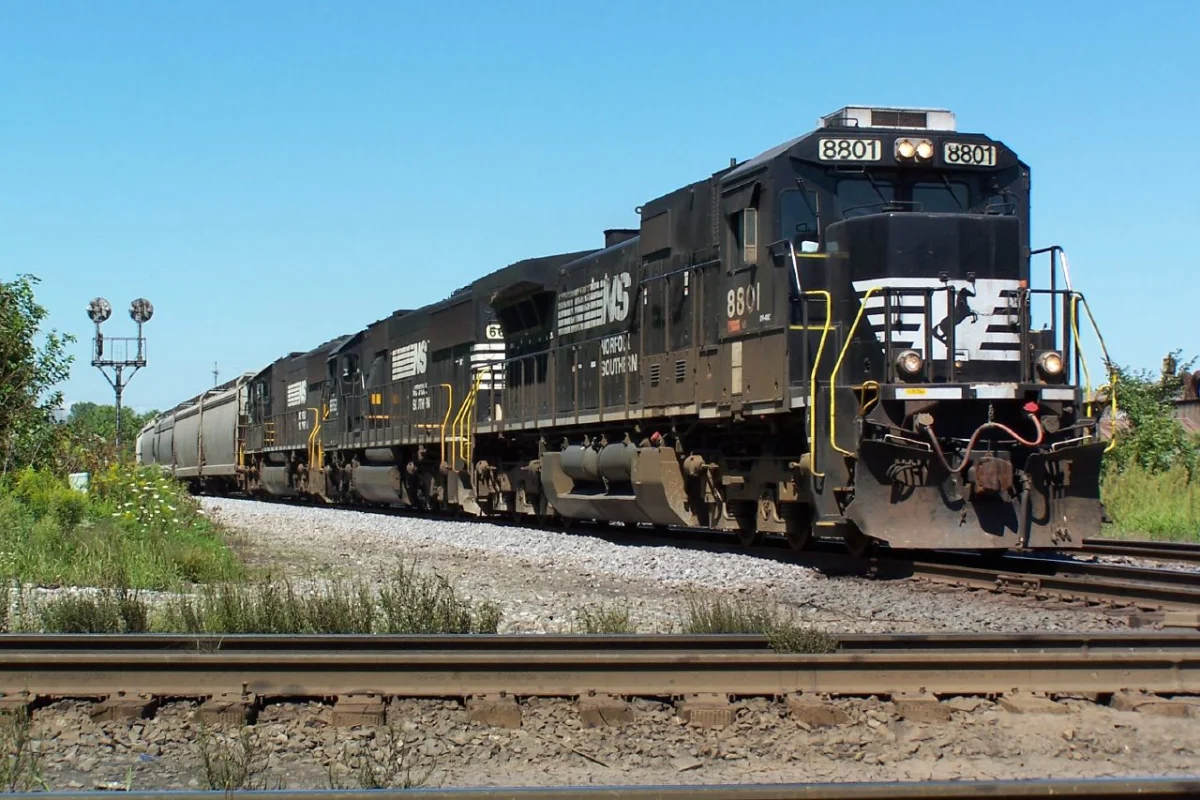
Photo: Norfolk Southern freight train in normal service at Marion, Ohio, 1 September 2007 (illustration, not the train involved) — John Mueller, Wikimedia Commons, CC BY 2.0.
Article written with the help of artificial intelligence from the sources cited, reviewed by the TrainsNews editorial team before publication.
Whats your reaction
 Like
0
 Dislike
0
 Love
0
 Funny
0
 Wow
0
 Sad
0
 Angry
0

TrainsNews est un média indépendant et bilingue d'actualité ferroviaire mondiale, publié depuis 2024. La rédaction couvre la grande vitesse, le matériel roulant, l'infrastructure, la signalisation et les télécoms ferroviaires (ERTMS/ETCS, CBTC, FRMCS, GSM-R), l'exploitation, le fret et le financement des projets. Chaque article cite ses sources et donne les chiffres avec leur total. TrainsNews is an independent, bilingual (French/English) news outlet covering the global rail industry since 2024: high-speed rail, rolling stock, infrastructure, signalling and telecoms, operations, freight and project financing. Every article cites its sources.
The rail month in one PDF: news and guides summarised, with their photos.
The rail month in one PDF: news and guides summarised, with their photos.









Comments (0)