

China opens 1,445 km of new high-speed lines in four months, with 302 km more due in October
Between June and the end of September 2026 China opened 1,444.9 km of high-speed line, including four lines on 28 September. A further 302 km network linking Fuyang, Huaibei and Bengbu is expected to open later in October.
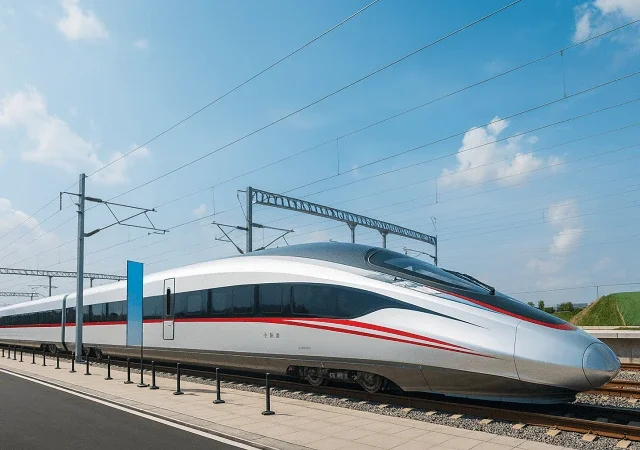
China opened four high-speed lines on 28 September 2026, adding more than 1,100 km to its network in a single day, according to China State Railway Group (China Daily, 28 September 2026). Counting the lines opened since June, 1,444.9 km of new high-speed route entered service in four months. For context, the national high-speed network passed 50,000 km in December 2025, and the government's target is about 60,000 km by 2030.
The new lines at a glance
| Xiong'an – Shangqiu | 552 km, up to 350 km/h, opened 28 Sep. Links Hebei, Shandong and Henan; fastest end-to-end trip 2 h 27 min |
| Harbin – Yichun | 318 km, 250 km/h, opened 28 Sep. Harbin–Yichun in 1 h 46 min; Yichun West is China's northernmost high-speed station |
| Xi'an – Ankang | About 171-180 km, 350 km/h, opened 28 Sep. Xi'an East–Ankang West in 45 min, against about 3 h before |
| Yichang – Xingshan | About 101-109 km, 350 km/h, opened 28 Sep. Cuts Wuhan–Chongqing from 4 h 56 min to 3 h 54 min |
| Xi'an – Shiyan | 256.9 km, 350 km/h, opened 30 June. Completes the Xi'an–Wuhan corridor |
| Wenling – Yuhuan branch | 37 km, 350 km/h, opened 8 Aug |
| Next | 302 km Y-shaped network Fuyang–Huaibei / Bengbu, expected later in October 2026 |
Lengths differ slightly between sources depending on whether station throats and connecting spurs are counted; the figures above use China State Railway data where available.
No easy building left
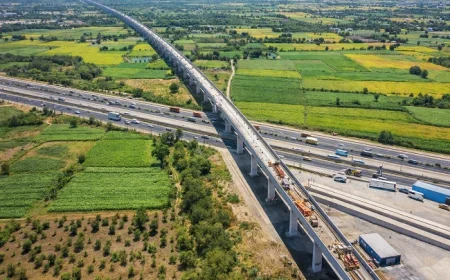
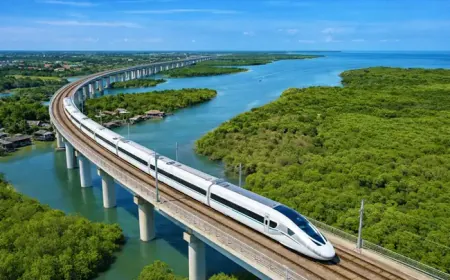
The striking number is not the length but the share of structures. On the new lines, bridges and tunnels make up about 88% of route length: 93% of Xiong'an–Shangqiu runs on viaducts across the North China Plain, while Yichang–Xingshan is 94% in tunnels or on bridges through the mountains of western Hubei. China's flat, densely populated corridors were built first; what remains is either long viaducts over farmland and floodplains or tunnels through difficult terrain, which raises cost per kilometre.
The new lines also reach smaller cities and counties. Ankang and two neighbouring counties get high-speed service for the first time, and the Harbin–Yichun line brings the forested north of Heilongjiang within two hours of the provincial capital, compared with about seven hours before.
An engineer's view
Opening several lines on the same day is a signalling and operations exercise as much as a civil one: each line needs CTCS-3 (or CTCS-2 on 250 km/h lines) commissioned, timetables integrated into the national graph and joint testing completed months in advance. China has industrialised that process. The other lesson is maintenance: a network where most track sits on viaducts relies on ballastless slab track and continuous structural monitoring, a model now being studied in the Gulf, where long-distance high-speed projects are taking shape (UAE high-speed rail by 2030).
Related reading
- Hong Kong confirms the Western Rail Link and Northern Link for 2026-2030
- UAE railway projects guide
- Saudi Arabia Railways orders 10 more Stadler inter-city trains
FAQ
How long is China's high-speed rail network?
It passed 50,000 km in December 2025 and keeps growing; about 1,445 km opened between June and September 2026 alone. The target is around 60,000 km by 2030.
What is the longest new line opened in 2026?
Xiong'an–Shangqiu, 552 km at up to 350 km/h, opened on 28 September 2026.
Which high-speed station is the furthest north in China?
Yichun West, on the Harbin–Yichun line in Heilongjiang, opened in September 2026.
Whats your reaction
 Like
0
Like
0
 Dislike
0
Dislike
0
 Love
0
Love
0
 Funny
0
Funny
0
 Wow
0
Wow
0
 Sad
0
Sad
0
 Angry
0
Angry
0

TrainsNews est un média indépendant et bilingue d'actualité ferroviaire mondiale, publié depuis 2024. La rédaction couvre la grande vitesse, le matériel roulant, l'infrastructure, la signalisation et les télécoms ferroviaires (ERTMS/ETCS, CBTC, FRMCS, GSM-R), l'exploitation, le fret et le financement des projets. Chaque article cite ses sources et donne les chiffres avec leur total. TrainsNews is an independent, bilingual (French/English) news outlet covering the global rail industry since 2024: high-speed rail, rolling stock, infrastructure, signalling and telecoms, operations, freight and project financing. Every article cites its sources.












Comments (0)