
CrossCountry Voyager Refurbishment: £75M for 70 Modernised Trains
CrossCountry and Alstom transform 70 Voyager trains with new seats, USB-C and CCTV. Discover the most ambitious rail refurbishment programme in Britain.
 TrainsNews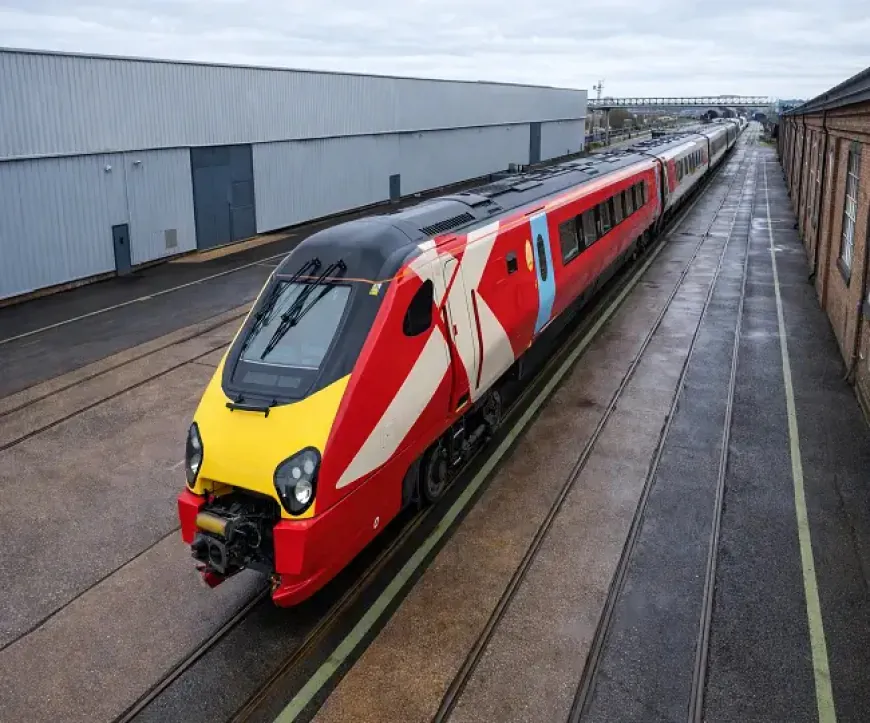
CrossCountry unveils the first refurbished Voyager train as part of a £75.1 million programme that will transform 70 units by 2028 with new seats, USB-C connectivity, CCTV and automatic passenger counting.
Updated on February 11, 2026
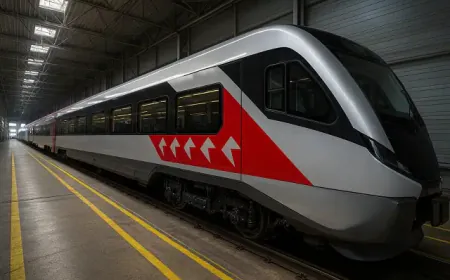
Derby, United Kingdom — On February 12, 2026, Alstom unveiled the first fully refurbished CrossCountry Voyager unit to the public at its historic Litchurch Lane Works. This train, number 220033, has covered 9.3 million kilometres since entering service in 2000, equivalent to twelve round trips to the Moon. It inaugurates a vast modernisation programme covering the entire fleet of 70 units by late 2028. The £75.1 million investment led by Beacon Rail, owner of the fleet, aims to extend their operation by at least fifteen years while offering passengers comfort and technology comparable to brand-new trains.
The "Passenger Hub": More than just a seat change
The interior transformation centres on a complete redesign of the passenger experience. CrossCountry and Alstom have installed new seats designed by Italian manufacturer FISA, recognised for its expertise in rail and road public transport. These seats incorporate bespoke cushions providing better lumbar support and adjustable headrests. Every seat now features British three-pin power sockets, USB-A and USB-C ports — a first for this fleet, which had never benefited from such connectivity infrastructure.
The layout has been designed to maximise comfort without reducing total train capacity. This important technical constraint required maintaining the exact number of seats to avoid disrupting the electronic reservation system already in place. Alstom's engineers optimised floor space by improving under-seat storage and slightly increasing legroom through a redesign of tables and seat-back structures.
Axminster carpets, a high-quality standard in the rail transport sector, replace the original flooring. Toilets and vestibule areas have been completely refurbished, while full LED lighting reduces energy consumption while offering better-distributed illumination.
| Feature | Before refurbishment (2000-2025) | After refurbishment (2026+) |
|---|---|---|
| Power sockets | Limited, no USB | 3-pin, USB-A and USB-C at every seat |
| Seats | Original Bombardier design | FISA with enhanced ergonomic cushions |
| Lighting | Traditional fluorescent | Full LED (consumption reduction ~30%) [to be verified] |
| CCTV | Partial single-angle coverage | Journeo 360° interior system + forward-facing cameras |
| Passenger counting | 6 units equipped only | 70 units with real-time automatic counting |
| Carpet | Standard worn | High-quality Axminster |
| Connectivity | None at seats | Universal (3-pin + USB-A + USB-C) |
| Passenger information | Standard displays | Displays retained, space available for future upgrade |
Security and Data: The digital brain of the new Voyager
One of the major contributions of this refurbishment concerns the integration of modern surveillance and data collection systems. The Voyager fleet was among the last generations of British trains built before CCTV became standard equipment. Journeo, a British specialist in information technologies for public transport, signed a £4.2 million contract with Alstom in May 2025 to equip the fleet's 312 vehicles.
The new CCTV system offers 360-degree interior coverage and forward-facing cameras on every unit. High-definition images are securely stored and accessible in real time by on-board staff and management teams. In parallel, automatic passenger counters provide instant occupancy data, enabling optimised flow management and informing passengers about seat availability even before the train arrives at the station.
These technologies rely on Journeo's SaaS platform, which centralises critical operational data. Journeo anticipates approximately £2 million in additional revenue over five years for associated subscription and support services. The LED lighting, already mentioned, also contributes to a significant reduction in electricity consumption, aligning with CrossCountry's sustainability objectives.
Steve Harvey, Alstom's Services Director for the UK and Ireland, emphasised that "upgrading a fleet as intensively used as the Voyagers demands precision, innovation and deep technical knowledge — and our people have delivered exactly that". Approximately 130 employees from the Derby Litchurch Lane factory, which will celebrate its 150th anniversary in 2026, are mobilised on this project.
The "Saturday" challenge: Series refurbishment logistics
Refurbishing an actively operating fleet constitutes a major logistical challenge. Alstom and CrossCountry have developed an ambitious industrial schedule: from April 2026, one unit will be withdrawn from service every Saturday to enter refurbishment, while another, freshly transformed, will rejoin the network on the same day. This pace of one unit per week ensures that total fleet capacity remains stable while completing the entire programme by late 2028.
The first train, 220033, required a longer preparation time. Teams had to understand how the materials had aged and identify areas requiring particular attention. CrossCountry confirmed that corrosion of the steel bodies was in line with expectations for trains of this age, with no major anomalies. This initial diagnosis refined procedures and enabled a transition to accelerated series refurbishment pace.
The twelve additional units, recently transferred from Avanti West Coast, will be processed last. They had already undergone partial refurbishment and will require more extensive modifications to harmonise their configuration with the rest of the CrossCountry fleet.
Another notable point: the decision not to pursue engine hybridisation, considered in the past. CrossCountry and Beacon Rail preferred to invest in an optimised fuel management system. This software automatically shuts down certain engines when required power is reduced, particularly between station stops. The operator is currently studying improvements to further refine this real-time management.
Rob Dee, Beacon Rail's Chief Commercial Officer, recalled that the Voyager fleet represented Beacon's first major investment in the United Kingdom in 2017 and that "at the time of purchase, Beacon was more than aware that the fleet had not seen any real investment since introduction". This refurbishment programme therefore addresses a twenty-five-year gap.
Context & stakes
Voyager trains were built by Bombardier Transportation between 2000 and 2002 to replace locomotive-hauled sets inherited from British Rail. At the time, the introduction of air conditioning, electronic reservation systems and passenger information enabled passenger numbers on CrossCountry long-distance lines to double, rising from 12 million in 1997 to 24 million in 2007. In 2025, CrossCountry recorded 39.6 million journeys on a network serving more than 100 stations between Aberdeen in Scotland and Penzance in England.
The choice to refurbish rather than replace aligns with economic and environmental sustainability logic. Purchasing 70 new trains would represent an estimated investment of several hundred million pounds, not including design and delivery timescales. Refurbishment extends the life of existing materials by an additional fifteen to twenty years, while reducing the carbon footprint associated with manufacturing new trains.
Furthermore, British rail infrastructure evolves slowly. The lines used by Voyagers are not all electrified, and large-scale electrification projects remain limited. Maintaining a diesel fleet, but with optimised fuel management, constitutes a realistic short- and medium-term compromise.
What changes for passengers
Concretely, passengers will notice several improvements from their first use of refurbished units. Universal connectivity is the most visible asset: smartphones, tablets, laptops can be charged simultaneously thanks to the three types of sockets available. On a four-hour journey between Manchester and Penzance, for example, a passenger can fully recharge several devices without worrying about running out of battery.
Seat comfort has been enhanced by adding thicker cushions and better lumbar support. Tables have been widened to accommodate laptops up to 15 inches. Under-seat storage now allows a standard cabin bag to slide in without restricting legroom for the passenger seated behind.
Perceived security also benefits from the comprehensive CCTV system. Passengers and on-board staff can rely on a better-monitored environment, deterring inappropriate behaviour.
Finally, real-time information on train occupancy will eventually guide passengers towards less crowded coaches, reducing the impression of overcrowding at peak times.