
SNCF and Sun-Ways test solar panels on railway tracks
SNCF partners with Sun-Ways to test removable solar panels between rails in Switzerland. Results expected in 2028 for potential French deployment.
 TrainsNews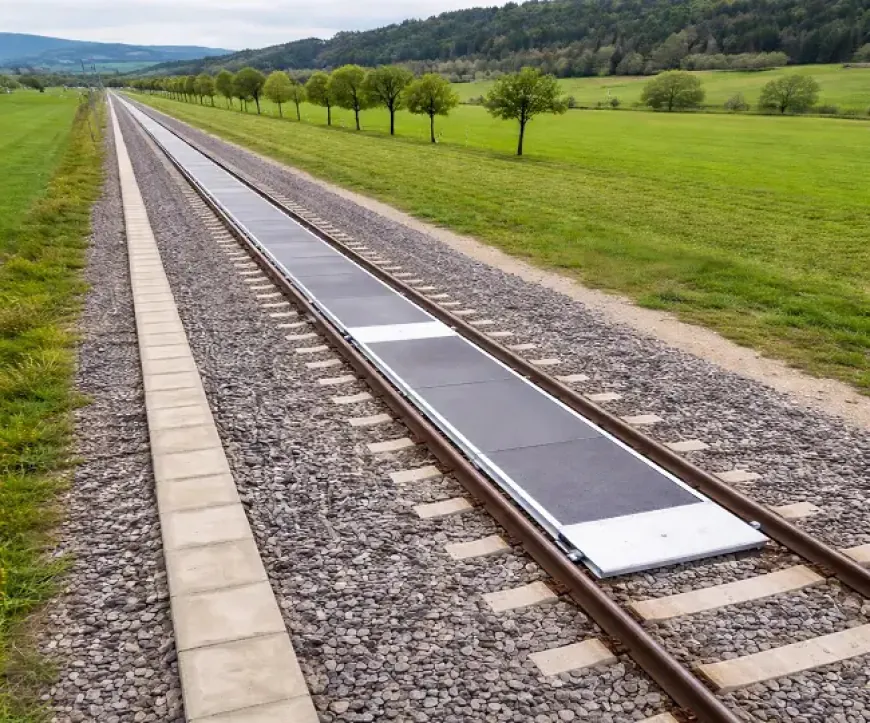
French rail operator SNCF and Swiss start-up Sun-Ways have formalized a unique partnership to assess the feasibility of a removable solar power plant installed directly between the rails of an operational railway line. The pilot project, launched in April 2025 near Buttes, Switzerland, will run until 2028.
Updated on February 17, 2026
A unique cross-border partnership
The collaboration brings together the SNCF Group, France's largest electricity consumer, and Sun-Ways, a Swiss start-up specializing in railway photovoltaics. This emerging field involves generating solar energy directly on rail infrastructure. The agreement, signed in November 2025 and announced on February 2, 2026, makes SNCF a partner in the Swiss pilot project.
SNCF's Technologies, Innovation and Projects Division, working with SNCF Réseau, gains access to production data, operational feedback and technical expertise developed by Sun-Ways. The primary objective is to study how these removable photovoltaic installations affect track maintenance and inspection operations.
An operational pilot installation in Switzerland
The test site is located near Buttes station in the canton of Neuchâtel, on the TransN regional network. Since April 24, 2025, solar panels have been installed on a new 100-meter section of Line 221. This segment handles 30 trains per day traveling at speeds up to 90 kilometers per hour, ensuring real operating conditions.
The innovation lies in the panels' removable design. Unlike conventional photovoltaic installations, these modules can be quickly removed to allow heavy railway maintenance work. Sun-Ways has developed a patented mechanical system, in partnership with Swiss company Scheuchzer, capable of deploying up to 300 meters of panels per hour without disrupting traffic.
Technical specifications
The installation comprises 48 solar panels rated at 380 watts each, representing a total installed capacity of 18 kilowatt-peak. Estimated annual production reaches 16,000 kilowatt-hours, equivalent to the electricity consumption of approximately four average households. The energy produced is fed into the public grid located 500 meters from the site.
After nine months of operation, Joseph Scuderi, founder of Sun-Ways, reports that actual production matches forecasts. The yield reduction due to the panels' lack of tilt is around 10 percent, a result consistent with initial assumptions. Electrical connections are secured inside the modules, and a cylindrical brush cleaning system attached to the rear of trains ensures the photovoltaic surfaces remain clean.
Project objectives and evaluations
The testing program spans three years, until April 2028. During this period, Sun-Ways conducts a series of tests under real operating conditions. Teams evaluate how easily the photovoltaic modules can be installed and removed, an essential criterion for compatibility with railway constraints.
The analysis also examines glare risks from the glass comprising the panels. Regular track inspections, including rail gauge measurements and clearance checks, verify that the installation does not interfere with railway safety. Panel soiling over the seasons receives particular attention, as does the impact of vibrations and mechanical stresses induced by repeated train passages.
The data collected will enable SNCF to assess whether deploying this technology on the French rail network makes sense. Maintenance teams are specifically analyzing whether these installations complicate or, conversely, integrate seamlessly into daily operations.
Context & challenges for SNCF
The SNCF Group, France's largest electricity consumer with annual consumption of approximately 9 terawatt-hours, actively seeks solutions to secure energy supplies and green its electricity mix. The company is also France's second-largest landowner, with over 100,000 hectares of land and 12 million square meters of built surfaces.
The SNCF Renouvelables subsidiary, created at the end of 2023, is tasked with deploying solar power plants on the group's vacant land and building rooftops. The stated goal is to install 1,000 megawatt-peak of photovoltaic capacity by 2030, equivalent to a nuclear reactor's output. This strategy aims to cover 20 percent of the group's electricity needs through self-consumption.
The partnership with Sun-Ways fits into this dynamic. It offers the possibility of increasing renewable energy production without additional land acquisition, while fully preserving train operations. For Sun-Ways, SNCF's support represents strategic validation. The start-up announces pilot projects in France, Spain, Romania and South Korea, and claims to have attracted interest from partners in China, Thailand, Australia and the United States.
What changes for passengers
For travelers using trains daily, this innovation remains invisible. No changes affect schedules, frequency or journey comfort. Trains continue to run normally on the section equipped with solar panels, and railway staff can access the track following standard protocols.
The impact is indirect. By producing locally part of the electricity used by the rail network, operators reduce their dependence on energy markets. This increased autonomy helps stabilize operating costs over the long term, a factor that could limit future fare increases.
Beyond economics, the project contributes to the transport sector's ecological transition. Each kilowatt-hour produced by railway panels represents electricity that does not need to be purchased from the grid, thus reducing the overall carbon footprint of rail transport, already considered one of the least polluting modes of travel.