
Vietnam High-Speed Rail 2025: North-South + Siemens-Vinspeed
1,541 km, $67B, 350 km/h: discover Vietnam's high-speed rail project and the Siemens-Vinspeed alliance. Timeline, technology, challenges.
 TrainsNews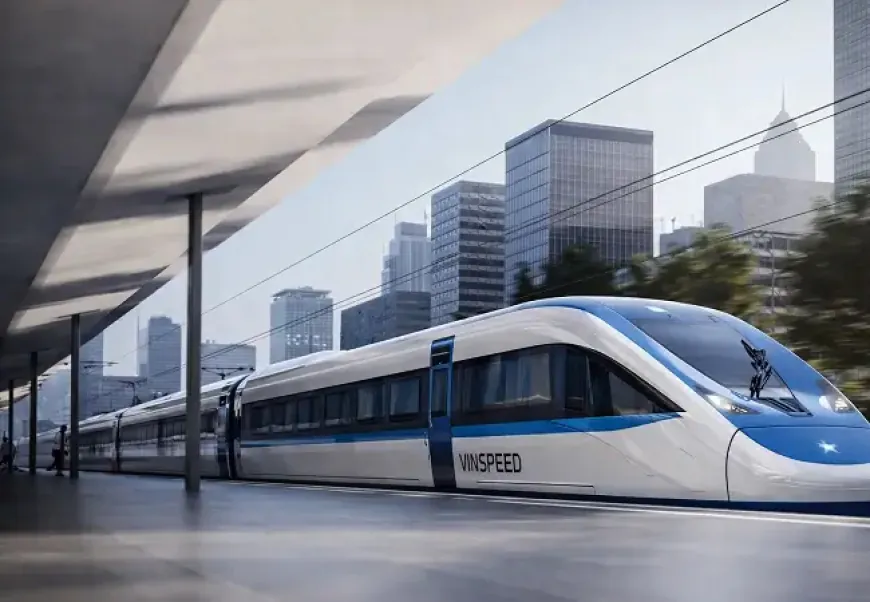
Vietnam reaches a decisive milestone in modernizing its rail infrastructure with progress on its first high-speed line connecting Hanoi to Ho Chi Minh City and a strategic partnership between Siemens Mobility and Vinspeed for key regional projects.
Updated on January 6, 2026
Vietnam's North-South high-speed railway will link Hanoi to Ho Chi Minh City over 1,541 km. Approved by the National Assembly in November 2024, it will cost $67 billion and enable travel at 350 km/h by 2035, reducing journey time from 30 hours to 5 hours.
The national ambition: 1,541 km to connect North and South
The North-South high-speed railway project represents the largest rail infrastructure undertaking currently under development worldwide. Approved by Vietnam's National Assembly on November 30, 2024, this vital artery will span 1,541 km between Ngoc Hoi Station in Hanoi and Thu Thiem Station in Ho Chi Minh City. The double-track line with standard international gauge (1,435 mm) will allow speeds reaching 350 km/h.
The network will include 23 passenger stations and 5 freight stations distributed across 20 provinces and cities. Total investment is estimated at $67 billion, financed primarily by the Vietnamese state through budgetary funds and state bonds. According to the French Treasury Directorate General, Vietnam plans to mobilize approximately 70% of the budget for civil engineering using local financing, and 30% for systems and rolling stock using foreign financing.
Minister of Construction Tran Hong Minh heads a steering committee tasked with ensuring schedule compliance. Assisted by Deputy Minister Bui Xuan Dung, this committee identifies two major challenges: land clearance and preventive relocation of electricity and telecommunications networks. These logistical obstacles determine the launch of works planned before end-2026.
Vingroup's strategic withdrawal: a resource redeployment
In an official document dated December 25, 2025, Vingroup formally requested the Vietnamese government to withdraw its investment application for the North-South line. This bid had been submitted in May 2025 with an investment proposal of $61.35 billion, approximately 13% of Vietnam's 2024 GDP.
The conglomerate justifies this withdrawal through a strategy of concentrating resources on projects recently entrusted by the government. Among these priorities are the Olympic Sports Urban Zone covering over 9,000 hectares with the Trong Dong national stadium, as well as other major industrial and energy projects including the VinMetal steel mill, two wind farms in Ky Anh, an LNG thermal power plant in Hai Phong, and the Can Gio coastal megapolis.
Vingroup emphasizes that other leading investors remain candidates for the North-South project, notably Thaco Truong Hai, the Vietnam Railway Transport Company, and the Vietnam 3000 Group. The group states that its withdrawal will not affect implementation of the national project.
Despite this disengagement from the North-South project, Vingroup maintains its railway ambitions through its subsidiary Vinspeed, which now focuses on two strategic regional lines totaling an investment of approximately VND202 trillion ($7.68 billion).
The Siemens-Vinspeed partnership: cutting-edge technology
On December 17, 2025, VinSpeed High-Speed Railway Investment and Development Joint Stock Company (a Vingroup subsidiary) and Siemens Mobility signed a comprehensive strategic partnership agreement and framework agreement in Hanoi. This alliance marks a technological turning point for Vietnamese railway development.
Siemens Mobility becomes the main technology partner, responsible for design, supply, and integration of Velaro Novo high-speed trains and key railway subsystems. Michael Peter, CEO of Siemens Mobility, stated during the signing that "Velaro Novo, our most advanced high-speed train platform, delivers up to 30% lower energy consumption, 10% higher passenger capacity, and proven reliability, tailored for Vietnam's challenging terrain."
Pham Thieu Hoa, CEO of Vinspeed, emphasizes that "the combination of VinSpeed's project execution capabilities and deep understanding of the domestic market with Siemens Mobility's global experience and advanced technology will create a strong foundation for delivering international-standard high-speed rail lines."
Velaro Novo and ETCS Level 2: key technologies
Velaro Novo constitutes Siemens' latest high-speed train platform. Designed for a maximum speed of 350 km/h, this model offers at least 10% additional passenger capacity thanks to a wider carbody and optimized hollow-tube design. Its approximately 30% reduced energy consumption compared to previous generations decreases operating costs and emissions.
The lines will be equipped with the ETCS (European Train Control System) Level 2, a European train control system ensuring cab signaling via continuous GSM-R radio communication. This system enables immediate transmission of movement authorities, thus increasing line fluidity and capacity. ETCS Level 2 eliminates the need for lineside signals, reducing maintenance costs for trackside equipment.
The ATO (Automatic Train Operation) system complements ETCS by enabling automatic train traction and braking. This ETCS Level 2 + ATO combination guarantees a high level of safety, optimized energy consumption, and high operational availability. To simplify: implementing these railway projects means installing an ultra-fast nervous system in an immense body. Siemens and Vinspeed technology acts like an electronic brain ensuring everything circulates with surgical speed and precision.
Vinspeed's regional projects: Ben Thanh-Can Gio and Hanoi-Quang Ninh
Vinspeed is developing two regional high-speed lines that will precede the North-South project.
The Ben Thanh–Can Gio line spans 54 km between downtown Ho Chi Minh City and the coastal commune of Can Gio. Approved by the city's People's Committee on December 5, 2025, it requires an investment of approximately VND102,430 billion ($4.2 billion). The groundbreaking ceremony was held on December 19, 2025. Phase 1 includes two stations (Ben Thanh and Can Gio), while Phase 2 will add four additional stations. Commercial operation is scheduled for the first quarter of 2028, with an estimated travel time of 13 minutes between the two terminals.
The Hanoi–Quang Ninh (Ha Long) line covers 120 km across four provinces: Hanoi, Bac Ninh, Hai Phong, and Quang Ninh. Total investment is estimated at VND138,930 billion ($5.54 billion). The line will depart from the Vietnam Exhibition Center in Hanoi (Dong Anh District) and terminate at the Viet Hung forest park in Quang Ninh, opposite the Vinhomes Ha Long Xanh urban complex developed by Vingroup. Vinspeed plans to begin construction in the fourth quarter of 2025, with testing in late 2027 and commercial operation from the first quarter of 2028. The line will include four stations (including Gia Binh Station near the future Gia Binh Airport) and enable journeys of approximately 30 minutes.
Timeline and key implementation stages
For the North-South line, the provisional timeline is structured around several critical milestones. Minister Tran Hong Minh has set the objective of launching works before the end of 2026. Proposals for specific policy frameworks, investment models, and investor selection criteria must be finalized urgently.
The 2026 horizon marks the finalization of investment models and definitive investor selection. A detailed implementation schedule must be developed in collaboration with all stakeholders to meet the work commencement objective. The construction phase will extend over several years, with progressive commissioning of different sections.
The 2035 deadline remains the official target for complete route completion and launch of commercial operation across the entire line. This ambitious schedule requires rapid resolution of identified obstacles, particularly land acquisition and relocation of existing networks.
For Vinspeed's regional projects, timelines are significantly shorter. Both the Ben Thanh–Can Gio and Hanoi–Quang Ninh lines should be operational from the first quarter of 2028, thus offering Vietnam its first concrete experiences of very-high-speed rail transport.
Context & challenges
Vietnam's high-speed rail development is part of a national strategy for infrastructure modernization and economy decarbonization. The Vietnamese government has placed this program at the top of its priorities to accelerate growth while reducing carbon emissions.
The North-South line should contribute nearly 1% annually to Vietnamese GDP, according to Deputy Minister of Planning and Investment Tran Quoc. Improved connectivity between key regions will stimulate economic and tourism development while reducing dependence on particularly polluting air and road transport.
France plays a significant technical support role. The French Development Agency and SNCF organized a conference at the French Embassy in Hanoi in January 2025 to detail their support for developing Vietnamese railway infrastructure. Diego Diaz, SNCF representative, explained: "Creating a high-speed line requires building an entire ecosystem. We bring our expertise so Vietnam makes the best possible choices, whether technical, financial, or commercial."
The project also draws inspiration from international experiences. According to a report from the University of Transport and Communications of Vietnam (September 2025), Japan offers a model with its Shinkansen (safety, reliability, Transit Oriented Development), China illustrates a massive investment approach with 47,000 km of network, and Germany emphasizes the importance of environmental assessments and transparent competition.
What changes for users and stakeholders
For travelers, the time savings will be spectacular. Currently, the Hanoi–Ho Chi Minh City journey by conventional train takes approximately 30 hours. With the high-speed line, this time will be reduced to approximately 5 hours, a gain of 25 hours. This reduction will radically transform business and tourism travel between the North and South of the country.
In 2023, approximately 11 million passengers traveled by air between Hanoi and Ho Chi Minh City, with over 60 daily flights, making it one of the world's busiest air routes. The high-speed line will offer a competitive, comfortable, and more ecological alternative, contributing to the modal shift desired by authorities.
For operators, onboard technologies (ETCS Level 2, ATO) will enable optimized operation with reduced intervals between trains, thus increasing capacity and profitability. Automated systems will also reduce energy consumption by 30%, decreasing long-term operating costs.
Vietnamese industrialists will benefit from the technology transfer planned in the Siemens-Vinspeed agreement. Siemens commits not only to supplying equipment but also to accompanying the progressive localization of production and maintenance, thus developing local skills and Vietnam's autonomy in this strategic sector.