
SYSTRA–DB Win Key Systems Contract for India's HSR Line
SYSTRA and DB Engineering will manage signalling, SCADA and ticketing systems on India's first 508-km high-speed rail corridor. Contract value: ₹612 crore, January 2026.
 TrainsNews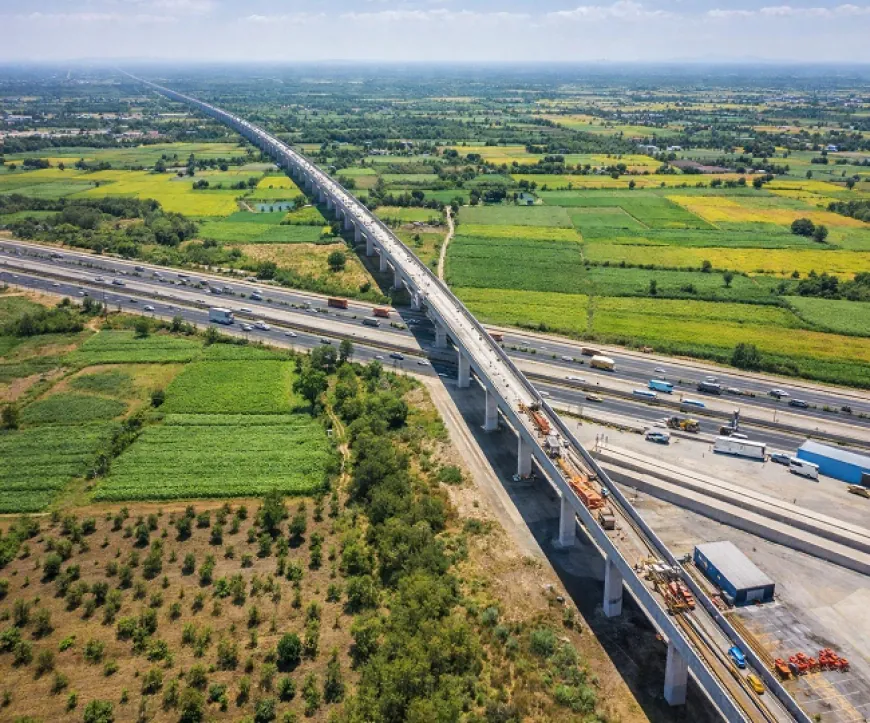
A French-German joint venture will oversee the critical technological systems of India's first high-speed rail corridor, a 508-kilometre line between Mumbai and Ahmedabad worth approximately ₹612 crore.
India's National High Speed Rail Corporation Limited (NHSRCL) issued a Letter of Acceptance on January 28, 2026, to the SYSTRA–DB Engineering & Consulting GmbH joint venture, concluding a tender process that had opened in August 2025.
Key Takeaways
- Contract scope: Project Management Consultancy (PMC) for signalling, SCADA and ticketing systems
- Value: approx. ₹612.13 crore (≈ ₹377.73 crore + €2.28 million), ~7-year duration
- Speed: 250 km/h average, 320 km/h maximum
- Express journey time: 2 hours 7 minutes versus nearly 6 hours today
- National ambition: 7 planned high-speed corridors in India totalling over 4,000 km
- Opening target: Surat–Bilimora section by 2027 [to be confirmed against NHSRCL primary source]; full line by December 2029 [to be confirmed against NHSRCL primary source]
Selected on Both Quality and Price
The award was made using the Quality and Cost Based Selection (QCBS) method, which scores bids on technical merit and financial offer simultaneously. The SYSTRA–DB consortium achieved the highest technical score of the two qualified bidders — the other being led by AYESA alongside ITALFERR and CEG — while also submitting the lowest financial offer. Financial bids were opened on January 9, 2026, with contract negotiations concluded on January 28.
With this award, all major consultancy packages for the MAHSR project have now been assigned, following the appointment of a Tata Consulting Engineers-led consortium for civil works back in 2021.
What the Mission Covers: Signalling, SCADA and Next-Gen Ticketing
The PMC scope encompasses three technology streams fundamental to safe and efficient high-speed rail operations. The first is signalling and telecommunications (S&T), which governs train movements and prevents collisions. The second is SCADA — Supervisory Control and Data Acquisition — the real-time monitoring and control platform for the entire infrastructure, to be operated from the corridor's control centre in Sabarmati. The third is next-generation automatic fare collection (AFC) and reservation systems, for which SYSTRA India has been conducting specification studies since 2024.
The SYSTRA–DB team will work in close coordination with the DRA Infracon–Siemens joint venture, awarded in June 2025 the ₹4,140 crore contract to supply and install the physical S&T equipment.
World-Class Performance on a Flagship Corridor
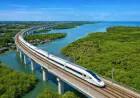
The Mumbai–Ahmedabad corridor (508.17 km, 12 stations) is engineered for trains running at up to 320 km/h, using Japanese Shinkansen technology. The express service — stopping only at Surat and Vadodara — will cover the route in 2 hours and 7 minutes, cutting today's conventional rail journey of nearly 6 hours by almost two-thirds. At full timetable capacity, 35 services per day in each direction are planned, with a 20-minute frequency during peak hours.
| Indicator | Value |
|---|---|
| Corridor length | 508.17 km |
| Number of stations | 12 |
| Maximum commercial speed | 320 km/h |
| Average speed | 250 km/h |
| Express journey time | 2 h 07 min |
| All-stops journey time | 2 h 58 min |
| Daily services (one direction) | 35 |
| Peak-hour frequency | Every 20 minutes |
| Total project cost (excl. taxes) | ≈ ₹1,08,000 crore (~US$17 bn) |
| JICA financing share | ≈ 81% |
The First Link in a 4,000-Kilometre National Network
The Mumbai–Ahmedabad line is the first of seven high-speed corridors planned by the Indian government, which will together add more than 4,000 km of new routes. The programme traces its origins to the Indian Railways Vision 2020, published in December 2009, which identified seven priority axes for high-speed rail development. The completion of all major consultancy contract awards for MAHSR is widely seen as a strong signal of the project's operational maturity.
Seven Decades of SYSTRA Expertise in India
SYSTRA has operated in India for nearly 70 years and, according to its own figures, is involved in approximately 50% of high-speed rail projects worldwide. Its current active portfolio includes the ALTO project in Canada (Québec–Toronto), the Merced–Bakersfield high-speed line in California, the LNSO project in France (Bordeaux–Toulouse–Dax, as owner's representative for SNCF Réseau), HS2 in the United Kingdom, and a high-speed extension consortium in Morocco.