

China's maglev prototype hits 800 km/h but remains far from passenger service
A 1.1-tonne vehicle reached 800 km/h on a 1 km test track in Hubei. The CRRC 600 km/h train is separate. Neither project has a commercial timeline.
A 1.1-tonne prototype vehicle reached 800 km/h in 5.3 seconds on a 1 km test track in Hubei province on 10 August 2026, according to CGTN. The run, the latest in a series of speed records on this track, uses electromagnetic propulsion and magnetic levitation, but the vehicle is not a passenger train and has no announced commercial application.
The test track belongs to the Donghu Laboratory High-Speed Magnetic Levitation Electromagnetic Propulsion Technology Innovation Centre, directed by Li Weichao. In a first run reported by International Railway Journal on 19 June 2025, the same vehicle hit 650 km/h in seven seconds over roughly 600 m, braking within 220 m using electromagnetic brakes. The system tracks position to within 4 mm. On 10 August 2026, it reached 800 km/h, with track alignment deviations held within 0.5 mm, CGTN reported.
The technology works by electromagnetic propulsion: a high-power linear motor accelerates the vehicle, which floats above the guideway through like-pole magnetic repulsion, eliminating wheel contact and leaving aerodynamic drag as the main resistance. CGTN describes it as working "like a giant slingshot" and says the same principle could be used to launch rockets and fighter jets, though no such programme has been announced.
A test bed, not a railway
The distinction matters. At 1.1 tonnes and 1 km, the Hubei prototype is an electromagnetic launcher, not a train that could carry passengers between cities. Japan's L0 Series, which recorded 603 km/h in April 2015, is a full-scale superconducting maglev train tested on a 42.8 km section of the Yamanashi test line, designed to carry passengers at 505 km/h on the planned 438 km Chūō Shinkansen between Tokyo and Osaka. Shizuoka Prefecture approved construction through its territory in July 2026, but the earliest opening is now 2036, according to Nippon.com.
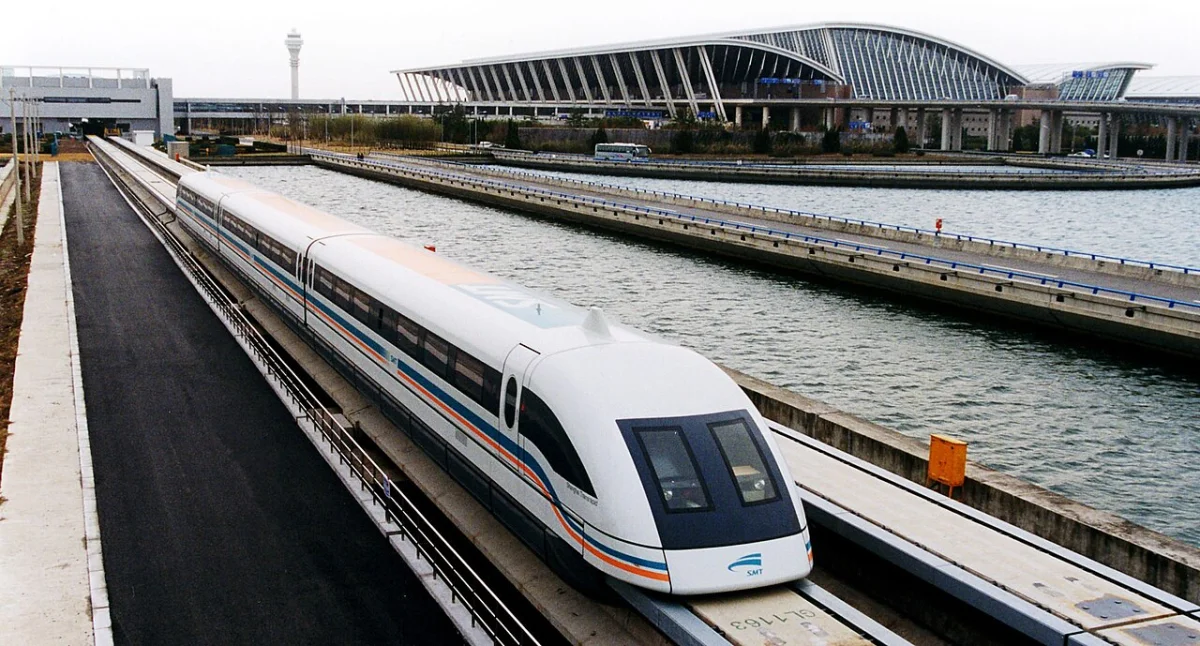
China has its own full-scale maglev programme, but it is separate from the Hubei tests. CRRC Qingdao Sifang rolled out a 600 km/h-design maglev train in July 2021, and CRRC Changchun showed a superconducting version at a Beijing exhibition in July 2025, according to Asia Times. That programme uses technology derived from Transrapid, the German system that powers the Shanghai Maglev, the world's only commercial high-speed maglev line, in service since 2004. No route or opening date has been announced for the CRRC 600 km/h train, and industry experts quoted by Asia Times expect commercial operation to take a long time. China Youth Daily noted that high-speed maglev would be viable only between the largest urban clusters, and that ticket prices would likely exceed conventional high-speed rail fares.
China's other maglev lines in passenger service run at much lower speeds: Beijing's line S1 and the Changsha airport link, both at 100 km/h. Construction began on a 48.7 km Changsha–Liuyang inter-city maglev with a top speed of 160 km/h, according to International Railway Journal. Neither the Hubei launcher nor the CRRC 600 km/h train has a timeline for carrying its first passenger.
Sources: International Railway Journal (19/06/2025); CGTN (10/08/2026); Asia Times (15/07/2025); Nippon.com, Chūō Shinkansen update.
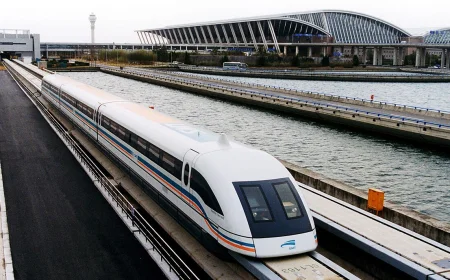
Photo: a Shanghai maglev train leaving Pudong International Airport. Alex Needham, public domain, via Wikimedia Commons.
Article written with the help of AI from the sources cited above, reviewed by the TrainsNews editorial team. Real photo, credited below the image. Spotted an error? contact@trainsnews.com – Our AI charter
Whats your reaction
 Like
0
 Dislike
0
 Love
0
 Funny
0
 Wow
0
 Sad
0
 Angry
0

TrainsNews est un média indépendant et bilingue d'actualité ferroviaire mondiale, publié depuis 2024. La rédaction couvre la grande vitesse, le matériel roulant, l'infrastructure, la signalisation et les télécoms ferroviaires (ERTMS/ETCS, CBTC, FRMCS, GSM-R), l'exploitation, le fret et le financement des projets. Chaque article cite ses sources et donne les chiffres avec leur total. TrainsNews is an independent, bilingual (French/English) news outlet covering the global rail industry since 2024: high-speed rail, rolling stock, infrastructure, signalling and telecoms, operations, freight and project financing. Every article cites its sources.
The rail month in one PDF: news and guides summarised, with their photos.
The rail month in one PDF: news and guides summarised, with their photos.



Comments (0)