


Global Rolling Stock Market Reaches Historic €65 Billion Peak in 2024
Global rolling stock market hits €65 billion in 2024 (+11% vs 2022). Discover challenges and industry leaders like CRRC, Alstom, and Siemens Mobility driving growth.
Global Rolling Stock Market Reaches Historic €65 Billion Peak in 2024
The global rolling stock market achieved a historic milestone in 2024, with total revenues reaching €65 billion. This exceptional performance represents an 11% growth compared to 2022, confirming the positive momentum of a railway industry experiencing significant expansion despite persistent challenges.
This remarkable growth comes alongside industry consolidation, with 24 manufacturers now exceeding the €500 million revenue threshold, representing seven more companies than just two years ago.
Key growth drivers behind exceptional performance
This record performance in the global railway market results from several convergent factors that have stimulated international demand.
Sustained demand across all sectors
Strong demand in both passenger and freight transport constitutes the first pillar of this growth. Massive public investments in railway infrastructure, particularly in Europe and Asia, have significantly energized the sector.
The worldwide surge in demand for low-emission transport solutions addresses environmental sustainability objectives. This trend aligns perfectly with public policies favoring energy transition and CO2 emission reduction.
Post-pandemic catch-up effect
A significant catch-up effect compensated for weaker business activity during the pandemic years. This accelerated recovery helped unlock postponed orders and activate new infrastructure projects.
Structural challenges threatening profitability
Despite full order books, the rolling stock industry faces complex challenges that temper overall profitability. "Full order books" do not automatically guarantee "stable value creation".
Supply chain disruptions
Continuous supply chain disruptions represent a major obstacle for manufacturers. These disruptions directly affect production schedules and generate significant additional costs.
Rising material and energy costs actively erode profit margins and cause delivery delays. This inflationary pressure forces companies to revise their pricing and sourcing strategies.
Skilled personnel shortage
The shortage of qualified personnel exacerbates production challenges. This structural problem limits manufacturers' ability to effectively respond to growing demand, creating an industry bottleneck.
Project financing is becoming increasingly difficult, complicating large-scale purchases. More restrictive credit conditions and economic uncertainty impact railway operators' investment decisions.
Contrasting performances of industry leaders
In this dynamic environment, leading manufacturers' performances reveal contrasting trajectories, illustrating each player's specific challenges.
CRRC: first revenue decline
CRRC, which remains the world's largest manufacturer and consistent sector leader, recorded its first revenue decline. This development marks a significant turning point for the Chinese giant that had previously dominated the global market.
Alstom and Siemens Mobility: solid growth
In contrast, Alstom and Siemens Mobility demonstrated robust performance, both reporting sales growth. These results testify to their adaptability to changing market conditions and successful geographical expansion strategies.
Stadler: strong demand despite environmental challenges
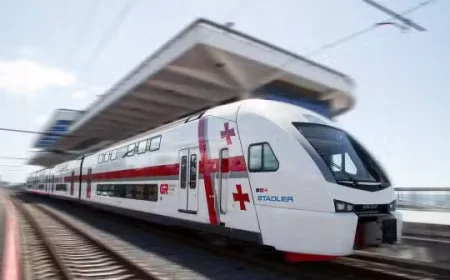
Stadler, based in Switzerland, achieved strong order intake in 2024. However, this positive performance was overshadowed by severe environmental events affecting three of its European manufacturing sites, forcing the company to postpone production worth several hundred million euros.
Russian manufacturers: exceptional growth
Russian manufacturers Transmashholding (TMH) and United Wagon Company (UWC) exhibited significant growth. This progression resulted primarily from strong domestic demand, influenced by international competitors' exit due to sanctions and increased military transport requirements.
Leaders' adaptation strategies
Facing these multiple challenges, leading manufacturers deploy comprehensive strategies adapted to their regional specificities.
Diversification and digitalization
Common strategies include expanding service businesses, diversifying portfolios, and implementing digitalization solutions. These approaches aim to create new revenue sources and improve operational efficiency.
Digitalization particularly enables predictive maintenance optimization, improved inventory management, and strengthened customer relationships through innovative connected services.
Industry outlook and constraints
Despite record order volumes, the global rolling stock manufacturing sector faces a critical constraint: its ability to transform these extensive orders into on-time deliveries and sustained profitable growth remains increasingly limited.
Persistent risks
The industry continues operating in a challenging environment where delivery disruption risks and margin pressures remain persistent. These structural challenges require profound business model adaptations.
Industry resilience is continuously tested by external shocks, highlighting the need to develop more robust risk mitigation strategies.
Conclusion: a sector in transformation
The global rolling stock market is experiencing a period of profound transformation. While demand remains sustained by sustainability objectives and infrastructure modernization, manufacturers must navigate a complex environment marked by major operational challenges.
Adaptability, technological innovation, and strategic diversification will determine tomorrow's leaders in this rapidly evolving industry.
Whats your reaction
 Like
0
Like
0
 Dislike
0
Dislike
0
 Love
0
Love
0
 Funny
0
Funny
0
 Wow
0
Wow
0
 Sad
0
Sad
0
 Angry
0
Angry
0

TrainsNews





Comments (0)