


83% of Europeans Demand Cross-Border High-Speed Rail Network
New study reveals 83% of EU citizens want improved transport links. 77% would choose train over plane for short and medium-distance travel across Europe.
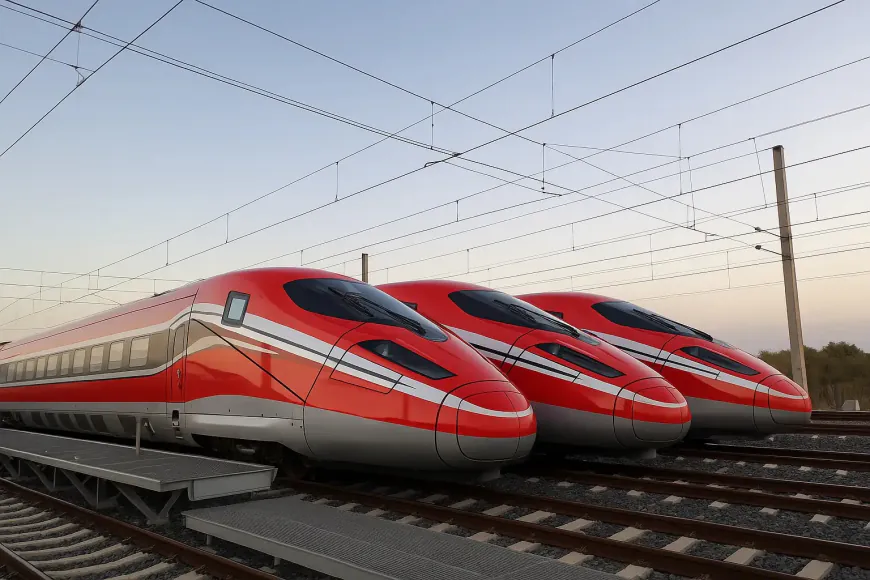
83% of Europeans Demand Cross-Border High-Speed Rail Network
A groundbreaking study reveals overwhelming European demand for high-speed rail development across the continent. According to the "EU High-Speed Rail: Citizen Demand and Investment Priorities" report published by Polling Europe, 83% of EU citizens believe transport links within the Union can be improved.
This comprehensive survey, conducted among 5,107 adults across all 27 EU countries, comes at a pivotal moment as the European Commission actively prepares a plan to connect all EU capitals and major cities through a high-speed rail network.
Survey methodology and European scope
The survey was conducted by Polling Europe, a Brussels-based polling firm specializing in European public opinion, in collaboration with European railway and infrastructure companies (CER).
Data collection took place from May 16 to May 25, 2025 using the CAWI (Computer Assisted Web Interviewing) method. To ensure representativeness, proportional quotas by sex and age were applied based on Eurostat data.
The report provides not only EU-wide results but also detailed breakdowns for Germany, France, Italy, Spain, and Poland, as well as for three distinct geographical groups: Central and Eastern Europe (CEE), Northern Europe, and Southern Europe.
Overwhelming citizen demand for transport improvements
The findings reveal massive demand for European transport link improvements. Among respondents:
- 49% state that links need improvement
- 34% believe they could be improved even if currently sufficient
- Only 10% consider current links adequate
Demand for improvement was highest in Southern Europe (90%) and Central and Eastern Europe (85%). France (79%), Germany (77%), and Northern Europe (79%) also showed high numbers of respondents identifying improvement needs.
Strong preference for rail over air travel
One of the most significant findings concerns the willingness to shift from air to rail transport. When presented with a hypothetical fast and reliable high-speed rail network, 77% of respondents indicated they would likely choose the train over a plane for short and medium-distance travel.
This propensity to switch transportation modes varies by region:
| Region | Percentage |
|---|---|
| Southern Europe | 85% |
| Spain | 86% |
| Poland | 81% |
| Northern Europe | 67% |
Central and Eastern Europe stands out particularly, with 48% of respondents stating they would be "very likely" to switch to high-speed rail under these conditions.
Massive support for European investment
The report also reveals strong support for public investment in high-speed rail. 79% of respondents agree that the EU should invest more in this sector to enhance international connectivity.
This approval breaks down as follows:
- 42% "strongly agree" with increased investment
- 37% "rather agree"
- Only 13% oppose additional investment
Spain and Southern Europe show the strongest enthusiasm, with 50% of respondents being strongly in favor of investment. Germany (17%) and Northern Europe (20%) display slightly higher levels of disagreement compared to the EU average.
Implications for the future of European transport
These results come at a strategic moment as the European Commission develops its plan for high-speed rail connections between European capitals and major cities. The strong citizen demand revealed by this study could influence investment decisions and political priorities.
The contrast between citizen preferences and current offerings highlights the urgency of accelerating European railway network development. With 77% of Europeans ready to prioritize trains for short and medium-distance journeys, the potential for transforming European transport appears considerable.
Towards a European transport revolution
This Polling Europe study highlights a remarkable convergence between citizen aspirations and European environmental objectives. High-speed rail development could simultaneously meet citizen expectations and contribute to CO2 emission reduction goals in the transport sector.
The observed regional disparities suggest the need for an approach adapted to geographical specificities and local needs. The particular enthusiasm of Southern Europe and Central and Eastern Europe could serve as a driving force for network expansion.
With limited opposition to public investment and clear citizen demand, conditions appear favorable for a major transformation of the European transport landscape. The challenge now lies in the ability of European institutions to translate this demand into concrete achievements.
"The overwhelming support for high-speed rail investment across Europe demonstrates that citizens are ready for a sustainable transport revolution. This study provides a clear mandate for accelerated development of cross-border rail connections."
As the European Union continues to pursue its Green Deal objectives and seeks to reduce transport emissions, this citizen support for high-speed rail investment provides a strong foundation for ambitious infrastructure projects that could reshape European mobility for generations to come.
Whats your reaction
 Like
0
Like
0
 Dislike
0
Dislike
0
 Love
0
Love
0
 Funny
0
Funny
0
 Wow
0
Wow
0
 Sad
0
Sad
0
 Angry
0
Angry
0

TrainsNews



Comments (0)